At the recent Alumni Weekend, the Class of '62 observed their 50th reunion (!), and they gathered for dinner on Friday night ...
First, Alan Rozinsky presented two gifts to the school. On behalf of classmate Steve Myers, he delivered two of Steve's photographs (Steve is an artist/photographer, and one of the photos had appeared in Life Magazine's 1999 Best Photos issue) to the school in honor/memory of Don Pierpont and Sid Clark. Steve wrote: "Their guidance and direction, bound together in an unlikely synthesis of methods, remains a lasting presence for all of us who received their help." Alan's second presentation concerned Hartford radio personality Bob Steele, who graced the local airwaves for fifty years (I distinctly remember my mother sitting on a beach in Maine and discussing the tenor of Bob Steele's voice with two neighbors; I thought it odd at first, but then I realized all three lived in Connecticut during the year; this was probably in the late 60s). Bob's son Phil has collected and published a series of scrapbooks that chronicle Bob's career, and Alan and Bobbie have donated a set to the school for use in the library and by the history department. They constitute a phenomenal resource for Hartford area history, and I can envision them getting much use by students as they "practice" history.
Not surprisingly, one of the better stories came from George Seifert. Don Pierpont had arranged for George to go to Parson's College, where Don was on the Board of Directors. When he got there, George adopted a St. Bernard puppy, which he named after Don. One day, when George was in class and his friends were exercising the dog, Don arrived for a board meeting and was confounded to hear a group of college students yelling for "Pierps"!
Thursday, May 31, 2012


Sunday, May 27, 2012
Rhymes With "Have On"
 |
| Singing Group from Early 40s |
Or perhaps Mrs. Riddle's "Avon" lived on into the 50s, changing over slowly until the current "Avon" won the day.
Friday, May 11, 2012
Coincidences
The other day, Alan Rozinsky '62, who with his wife Bobbie is soon to retire to Florida, ending decades of residence on campus and two teaching careers so illustrious they have recently been honored with the Alumni Order of Old Farms, handed me an envelope. Among the things in it was a tribute to legendary English teacher Sid Clark written by one of his former students, Thomas Steinbeck. Steinbeck tells the story of over-hearing Mr. Clark say to a stranger who had seemed to question the wisdom of Sid's career choice: "I'm always deeply impressed with those people who can see what is before them; happily I've always been blessed with the ability to see all the rest."
 Young Thom was so taken by that statement that he wrote it in bold on the inside cover of his binder during French class. Years later, when Thom had written a draft of a play, he presented to his father for his review, bound in that same AOF binder. The father's first question was not about the play but about the quotation inscribed in the binder. When Thom related the origin of the inscription, his father said "I know Sidney Clark. He was your English teacher," and headed for his own voluminous library. Soon, Thom's father produced a dusty tome and told him he would find the quotation on a certain page. Thom soon discovered that Sid had been quoting Euclid, and the full quotation reads; "I am ever profoundly awed by those wise beings that can see plainly what stands before them. Happily, the gods have blessed me with the ability to see all the rest."
 When Thom expressed his amazement that his father could make that connection and remember the book, his father told him to check the flyleaf, where he found "a yellowing Avon Old Farms library bookplate with Sidney Clark's name written at the bottom." It seems that Sid had loaned the book to Thom's father, who had yet to return it. For my money, this would be an interesting story if it ended here, but by now you'll have guessed that Thom's father's name was John and that he was himself adept at turning a phrase.
So why relate this story? Have I sacrificed the eloquence of Thom's tribute to Sid Clark in favor of an anecdote about an interesting coincidence made more interesting by the fact that one of the parties is a famous author? To me, the story speaks to the existence of a small community of Men of Letters, of which Sid Clark was definitely a member. It reminds me of a similar story involving a different Avon alumnus. One of my own English teachers once told of accompanying a friend to dinner at the home of a particularly highly-regarded and long-tenured professor of English at Yale. When after dinner the professor made a comment about the fascinating lives that words seemed to lead, my teacher knew he had once heard another of his teachers say very much the same thing. This was the 1970s, but my teacher asked if the professor might remember a particular student who would have been at Yale just after World War II. Despite the intervening years, the professor did remember his old student - my teacher's teacher. He was Eddie Custer, AOF '43.


So why relate this story? Have I sacrificed the eloquence of Thom's tribute to Sid Clark in favor of an anecdote about an interesting coincidence made more interesting by the fact that one of the parties is a famous author? To me, the story speaks to the existence of a small community of Men of Letters, of which Sid Clark was definitely a member. It reminds me of a similar story involving a different Avon alumnus. One of my own English teachers once told of accompanying a friend to dinner at the home of a particularly highly-regarded and long-tenured professor of English at Yale. When after dinner the professor made a comment about the fascinating lives that words seemed to lead, my teacher knew he had once heard another of his teachers say very much the same thing. This was the 1970s, but my teacher asked if the professor might remember a particular student who would have been at Yale just after World War II. Despite the intervening years, the professor did remember his old student - my teacher's teacher. He was Eddie Custer, AOF '43.
Sunday, March 25, 2012
Of Hamlet, Farm Chores, Floods & Weddings
Top billing (the front page) in the March 24, 1936 issue of The Avon Weekly News-letter is split between that spring's production of Hamlet and impending wedding of school store (not yet the Hawk's Nest) employee Oscar Bohman. Hamlet, despite keeping its audience of "nearly 190" in the Refectory for four and half hours, won rave reviews, with everyone from Mr. Whiting, who payed Hamlet, to Owre, who played (offstage) a rooster, earning plaudits. It seems Ben Custer '10 was not the first of his family to take center stage at Avon. Tom Custer '36 played Polonius, and his father (Ben's great-grandfather) Dr. Custer played the Ghost. Actors and stagehands will note that some things do not change - the dress rehearsal for Hamlet lasted until 4:30 AM - and some things do - actors were allowed to sleep through the first four classes the next day!
 In other news, Dr. Kammerer had announced a change in the way students would do farm work. It seems work and school conflicted, with students on farm duty constantly racing from one place to the other, with the result that they ended up doing busywork at the farm and not learning anything about agriculture. Under the new plan, boys were to spend "all 24 hours" at the farm on their appointed days. Philip Schenck '30, who had been to Connecticut Agricultural College, would be on hand to "coach them in the scientific application of modern agricultural knowledge."
There was a flood on the estate that week, and according to Verne it was every bit as high as the flood of '27. It also caused Verne to remember the sight of Mr. Iverson chasing a trout - on horseback (Mr. Iverson was riding a horse, not the trout) during the flood of '27.
Modern Avonians will wonder at this: in the Founder's Era, there were Effort Grades in addition to the academic ones. It seems that students who were on the Avon List (the top scholars) and had an A Effort Rating for the past several months were able to leave for spring break two days early! If one had only one of those two distinctions - or was on the Council - one could leave a day early...
Sunday, February 5, 2012
This Week in Avon History
The February 4th, 1936 issue of The Avon Weekly News-letter reminds us that student government really did some governing in the Founder's era. The issue of the day was lateness and the Village Council's standing rule that more than ten latenesses in a week would mean the entire school must check in at Sunday breakfast. When the newsletter came out on Tuesday, there were already eleven latenesses that week, and with the annual Mid-Winter Dance scheduled for Saturday night, the boys were hoping to be able to sleep in on Sunday. Commander Hunter saved the day by proposing both that the new boy's lateness be forgiven (he did not yet fully appreciate the rules) and that any further lateness that week be punished with two hours hard labor, thus sparing the rest of the school an early Sunday morning.
The News-letter also reported on the Town Meeting held the previous Friday. The Village Treasurer, Thomas Custer '36, reported that there was $231.35 in the treasury, which meant that, in the absence of a spike in breakage, there might be a general tax reduction. Also making a report was Village Attorney Reed Estabrook '36, who would go on to spend decades as Chairman of the Board of Directors.
One student suggested the Council appoint a commission to study the problem of tent caterpillars on the Estate and how best to exterminate them. A resolution to that effect passed unanimously, and William Whitney '36, the Warden, expressed his approval, as the solution to the tent caterpillar problem might well present an opportunity for "hard labor" to be assigned to any future late-comers.
 Also in the news that week: the boys had seen a movie about - and demonstration of - "seeing eye" dogs, the "Avon List" had been published, and it included both A. Sperry and M.L. Sperry (noteworthy in that they are science teacher Holland Sperry's two daughters Alice and Mary Lou), the Eagles and Diogenes teams had split a pair of recent hockey games, and the Thursday night fire drill was pronounced a success overall, despite a general lack of surprise.
The News-letter also reported on the Town Meeting held the previous Friday. The Village Treasurer, Thomas Custer '36, reported that there was $231.35 in the treasury, which meant that, in the absence of a spike in breakage, there might be a general tax reduction. Also making a report was Village Attorney Reed Estabrook '36, who would go on to spend decades as Chairman of the Board of Directors.
One student suggested the Council appoint a commission to study the problem of tent caterpillars on the Estate and how best to exterminate them. A resolution to that effect passed unanimously, and William Whitney '36, the Warden, expressed his approval, as the solution to the tent caterpillar problem might well present an opportunity for "hard labor" to be assigned to any future late-comers.

Sunday, January 29, 2012
Radio Silence
A little over a year ago, when I mentioned this project to a colleague from another school, he was quick to say - in the headmaster's presence - that the school should provide a sabbatical so I can complete it. While I certainly never expected (or really wanted) a sabbatical, I am beginning to see his point. It has been too long since I last made any real headway. It has been a hectic year at school to this point. The "Excellence in Teaching" initiative has gained some traction, but it has consumed time at a hefty clip. (This is an initiative that puts a focus on excellence in classroom teaching; one aspect is a conscious effort to provide teachers with more specific, more meaningful feedback on their teaching, which, of course, takes time.) Exams are under way, with grades and comments due soon, and a conference in Boston beginning tomorrow night. Thus, I do not anticipate doing much on this project for another week or ten days.
After that, I hope to get back to conducting interviews and taking notes on the interviews I've already conducted. So stay tuned; I haven't forgotten, and I hope to break the radio silence again soon with some interesting tidbits of Avon history.
After that, I hope to get back to conducting interviews and taking notes on the interviews I've already conducted. So stay tuned; I haven't forgotten, and I hope to break the radio silence again soon with some interesting tidbits of Avon history.
Sunday, December 18, 2011
Boar's Head
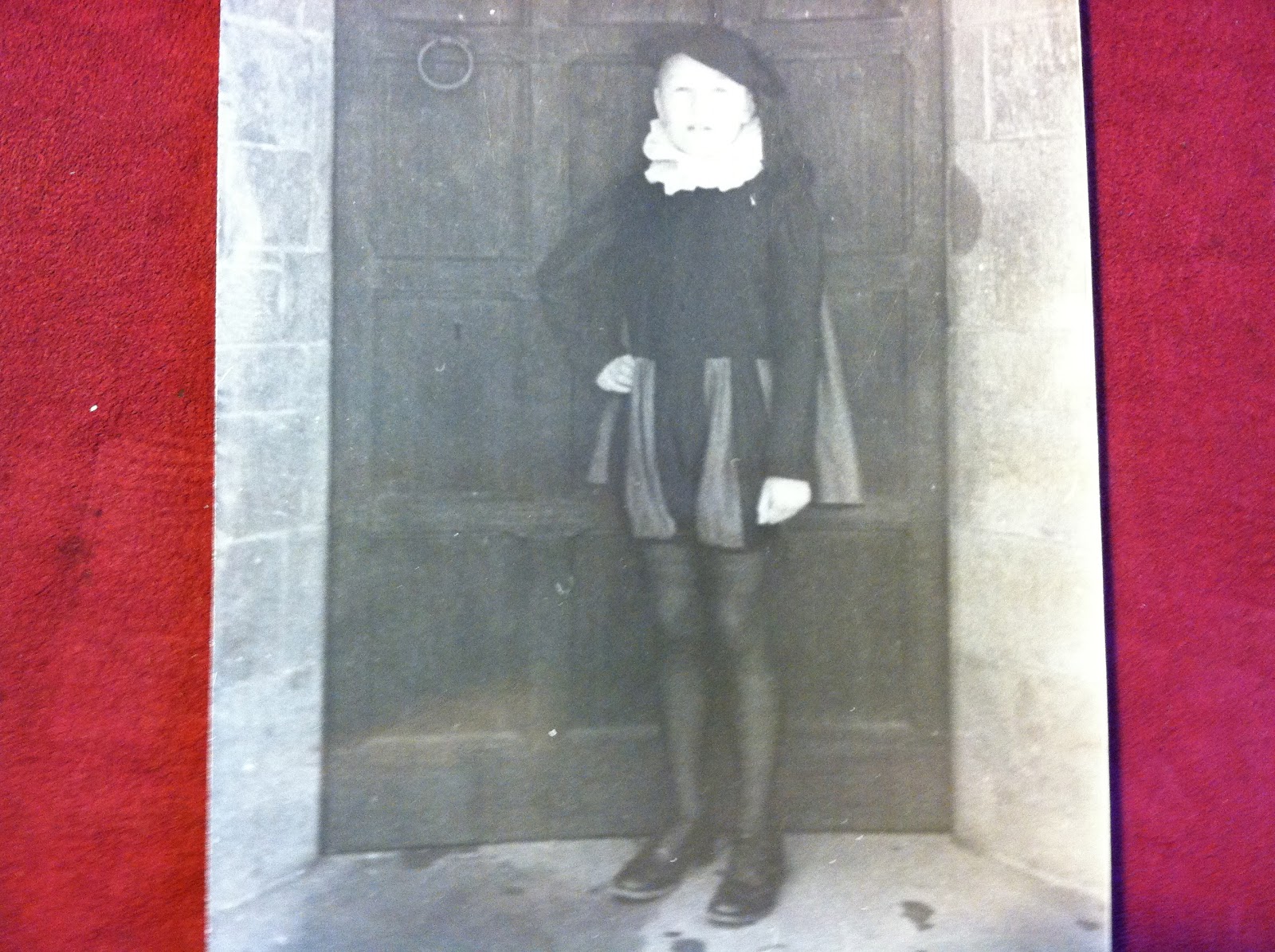
Aspiration and Perseverance, the history by Gordon Clark Ramsey, has the notes from the 1964 Boar's Head, and it looks as though very little has changed in the last 45 years. We still start with the Jester yelling "Make Way!" and finish - after St. George has vanquished the dragon - by singing "Auld Lang Syne." Most of the things in between - including many of the Jester's lines and songs we sing - remain unchanged. One thing that has changed is the musical entertainment. In 1964, and into the 80s, Brad Mason, a veteran of Broadway who held a variety of teaching and administrative posts (including directing Boar's Head), sang "O Holy Night" as a solo. Now, of course, we have the Riddlers, who offer a couple of musical interludes. Nonetheless, it is clear that any of the 1964 cast members would have been able to play his role again in 2011 without much of an adjustment.
Subscribe to:
Posts (Atom)