There should be some oases in this country where the love of tradition is fostered. Avon shall be one of these oases where, when Avonians return, they will find at least a semblance of permanence.
-Theodate Pope Riddle

Showing posts with label Founder's Era. Show all posts

Tuesday, February 26, 2019

Avon and the War


Recently, our Archivist, Dawn Driggs, left a few things aside for me to look at before she filed them away, and one of them is a pamphlet called Avon and the War. It presents itself as a summary of how the school was responding to the reality of World War II and how it was preparing students for their war-time futures. Of course there were additions to the curriculum, such as "a Pre-Flight Course" and a "Basic Officer's Training Course in Mathematics." There were new topics in old courses, as well. "In History," it says, "the subjects of global geography, the economic and other causes of the war, the mistakes of the last peace ... are among the topics receiving special emphasis."  

Note the name: The Avon School

All of that makes sense, of course, but this paragraph in particular caught my eye: Avon's unusual form of student government has assumed added significance during these war days. The entire school is organized as the Village of Old Farms, with its own law and courts, its own post office and bank, and with a government based on that of the New England township. The Student Council levies taxes, grants charters, floats bond issues, preserves the peace, promotes the public welfare - in fact deals with all everyday concerns outside the academic field. This form of student government is excellent training for citizenship and democracy. By actual contact with civic affairs and the assumption of genuine responsibilities, a boy becomes familiar with the workings of government and with the problems he must understand if later he is to take an active, intelligent interest in the welfare of his own community.

With the exception of the first sentence, this paragraph might have appeared in any Founder's Era school publication. Indeed, in many ways, this paragraph neatly captures Theodate Pope Riddle's progressive approach to education, which called for education by doing - an active approach which today would include making and experiential learning. While it might seem hardly surprising that a school publication would emphasize an educational philosophy dear to TPR's heart, note the name of the school. This was a document published by The Avon School and attributed to W. Brooke Stabler, Rector.

Within a few years, Stabler would resign his position and urge the entire faculty to do the same; when they did, TPR felt she had no choice but to close the school. Within the school community, there were those - my father was one - who felt that the Reverend Mr. Stabler was responsible for the rift with TPR, but the larger group - it included my grandmother - put the blame squarely on Mrs. Riddle. The latter group felt that TPR was meddlesome and overbearing, and that she created conditions under which Mr. Stabler could not be expected to continue - nor could anyone else. I mention all of this because the pamphlet Avon and the War serves as a reminder that Stabler was able to make a number of significant changes at school - including changing the name of the school - which leads me to wonder how tied his hands really were.

Friday, October 4, 2013

Who Was Mrs. Riddle?

Anyone who seeks to understand - let alone write about - the history of the school has to wrestle with the question of who Mrs. Riddle really was. We know the basics, of course: daughter of Alfred A. Pope, graduate of Miss Porter's, first registered female architect in Connecticut, Lusitania survivor, and founder of Avon Old Farms. We know that she had a reputation for eccentricity writ large. We know that she was, to put it mildly, strong-willed. We also know that these attributes have been caricatured in a series of popular myths/exaggerations about Mrs. Riddle. (She did not, for example, choose Percy Kammerer as Provost simply by finding his name in a telephone directory, and she did not have a roof torn down simply because it did not sag correctly.) The questions we confront are: how eccentric and strong-willed was she, and to what extent was she to blame for the departures of three Provosts and two entire faculties during the Founder's Era?
Theodate Pope Riddle

Certainly, there was a widespread perception at the time that TPR could be difficult to work with. Cal Magruder '46, for example, recalls that most of the faculty and most of the students sided with Provost Stabler rather than TPR in the conflict that would lead to his departure and the school closing. Time magazine chose to highlight the founder's eccentricities (and her progressive views on education) in their March, 1944 article on the closing. They no doubt enjoyed using the word "warped" to describe the sag in Avon's roofs and "Warped to Order" as a sub-heading for that section of the article. However, Time also chose to perpetuate the phone directory myth and suggested that Francis Froelicher and Percy Kammerer had "quit" after "rows," presumably with TPR. The reality is that neither of them had "quit" and that both had been guilty of behavior unbecoming of a provost and potentially damaging to the school.
Eddy Custer '43 was an exception to Cal Magruder's rule. He wrote his brother Tom ('36) that he has "always thought Mrs. Riddle was wonderful and Stabler horrible," but went on to quote his mother, the history teacher John S. Custer's wife, as referring to TPR as "a spoiled and ruthless old woman"! "Mother said Mrs. Riddle had imposed conditions under which Mr. Stabler could not possibly stay, but she didn't say what the conditions were." Frankly, it is hard to imagine. Provost Stabler had already instituted religious services at school - appointing himself "Rector" - and changed the name of the school.  It is not as thought TPR never let him take the initiative. Would that Eddy (Dad) or my grandparents were still around to shed some light on the subject.
As I get closer to being "finished" with my chapter on the Founder's Era (long-time readers will know that I have already both a) claimed to have completed such a draft and b) observe that "finished" is not a word one can ever truly apply to history), I am confronted with the necessity to address these questions. At the moment, I am inclined to conclude that a healthy measure of the anti-TPR sentiment of the day stemmed more from the biases of the day than from her own, admittedly quite real, idiosyncrasies. Once I have organized my thinking and taken a stab at the conclusion of this chapter, I'll write another post on this issue. In the meantime, do share any thoughts or understanding you may have!

Thursday, September 19, 2013

Letters From India

My father, Eddy Custer '43, joined the American Field Service immediately after graduation and spent a year serving in India as an ambulance driver and company clerk. Throughout his travels, he wrote lengthy letters to his parents and to his older brother Tom (AOF '36). Tom's daughter Barbara recently came across a cache of these letters and sent them to my brother. In many ways, these letters are typical of any young man off to war - filled with yearning for home, affection for loved ones, stories of the wonders and the tedium of travel and then service, and constant entreaties to write letters.
This embroidered seal accompanied the letters
For some reason, it had not occurred to me until I read these letters that the "home" for which Dad was pining as he started his journey would be gone by the time he returned. In the fall of '43, there was no inkling that Avon would not go on forever, and he mentions the excellence of the fare in the Refectory and Chef Candles' magnificent Thanksgiving feast among the many things he missed.
By the time Dad returned from India, the school would be closed, and his parents would no longer live in the Diogenes apartment where he grew up. He learned of the school's fate in a March, 1944 TIME Magazine article. In May, he wrote "I still can't believe Avon is closing. It seems like a fantastic nightmare." Later in the month: "I disagree with you that there are other places in this world equally nice. Any school after Avon will seem grim to me..." 

Monday, March 4, 2013

A Letter

Recently, archivist Carol Ketcham sent over a copy of a letter TPR sent to Gilman Ordway '44 in December of 1945.  She was pleased to have had a letter from Ordway, then a student at Yale, and pleased to learn he was rooming with Eddie Custer '43.  TPR clearly knew the boys; she knew that Eddie had served in India during the war and that he wrote poetry, and she knew Gilman was a writer as well (he has a neat story in the '44 yearbook).
She filled Ordway in on the activities of the Army on campus, especially the improvements such as the sprinkler system and the new pool, and she went on to express her hope that Avon would one day re-open as a school.  "Your letter," she wrote, "and the letters from other Avon boys, telling me you stand ready to support the school, cheer my heart."
It comes as no surprise that alumni supported the idea of re-opening the school.  It did, after all, re-open in 1948, something that could not have happened without a great deal of suport from alumni.  Neither is it a surprise that TPR knew and took an active interest in some recent alumni.  While she was not a constant presence on campus during the Founder's Era, she was here from time to time, and every alumnus of the period I have met can recount at least one story of meeting Mrs. Riddle.  TPR was fond of the quotation "by their fruits ye shall know them," and she said more than once that the school was her life.  In that context, one can only imagine how she felt about the school's closing (too distraught to attend Commencement in '44, she sat in her car on Dio circle) and how fervently she would have looked for signs that a re-opening would "take."

Wednesday, November 7, 2012

Refectory Supervision

I encountered Jock Davenport '59 at breakfast on Saturday (he was on campus for the meeting of the National Council), and we shared stories about Refectory supervision.  Jock said that when he was in school he heard stories about dinner during the Founder's Era.  Founder's Era students, of course, came to dinner more formally attired than any of their successors.  In Jock's day, the rumor was that the suit required during the Founder's Era was the same as that worn at Eton and that every night there was a shadowy caped figure on the balcony wielding binoculars.  This person was responsible for spotting and reporting any sartorial miscues the boys might have committed.  (This seems unlikely, but stranger things have happened.)
I asked Jock if he was aware of Don Pierpont's exceptional hearing.  It seems Don had an uncanny ability to discern what mischief the boys were up to and cut them off at the pass.  What the students did not know (at the time) was that Don's hearing was extremely good, and he would sit at the head table during meals and eavesdrop on the conversations going on at the nearest row of tables.  Thus it appears possible that Avonians, through the school's early years, could hardly take a meal without being subject to covert observation or eavesdropping!
Actually, breakfast was fertile ground for school history conversation last week.  Earlier in the week, Jonathan Crocker recounted his father's (student in the '28-'29 school year) memory that TPR might burst into a classroom and abscond with all the students for some project dear to her heart.  This is very interesting to me in that it is the first such story I have heard.  The Founder's Era alumni I've met do not remember seeing much of TPR, and I know that she and John Riddled traveled to Europe during the school's first year specifically to be out of the way.  On the other hand, it does sound like TPR ...

Monday, October 15, 2012

Board of Correlation?

A question that remains even after all this time is to what extent did TPR involve herself in the operation of the school.  It is abundantly clear that some people both inside and outside the community were under the impression that TPR was guilty of excessive meddling in the affairs of the school and that her meddling was responsible for the departure of three provosts and two entire faculties, the last of which led to the school's closing in 1944.  The Hartford Courant, after all, listed the "attitude of Mrs. Riddle" in its headline announcing the 1930 faculty departure, and Cal Magruder '46 reports that most of the community thought a conflict between TPR and Brook Stabler had brought about the closing.
Finding actual evidence of TPR's meddling, however, proves to be more elusive.  We do know she went to some lengths to instruct the school's telephone operator as to the correct pronunciation of "Avon," and we do know she insisted on an administrative structure that proved unpopular with both Provosts and candidates for Provost.  [The problem was the existence of a person - first Master of Detail and then Aide to the Provost - with primary responsibility for the non-academic aspects of the school.]  On the other hand, we also know that she and John Wallace Riddle traveled to Europe for most of the school's first year of operation, largely to be out of Provost Froelicher's way, and that TPR was not on campus on a regular basis once the school opened.  Indeed, Cal Magruder remembers meeting her only once during his two years at school.
This is why I am intrigued by a note in the December 3, 1935 issue of the Weekly News-letter about a meeting of the "Board of Correlation" that had take place in the prior week.  The Board had decided to reject the Comptroller's suggestion that community service boys might do clerical work; the Board's thinking was that it was better for the boys, who had been in class all morning, to be outdoors as much as possible in the afternoon and that having boys do clerical work would mean removing them from the helpful work they were already doing.  It seems like a routine and reasonable decision, but I find it intriguing because with its usual thoroughness the Weekly News-letter lists all the members of the Board of Correlation: Mrs. Riddle, Dr. Kammerer, Commander Hunter (Aide), and four other men.  This is the first time I have come across the Board of Correlation, but any committee that includes the Founder (and benefactor) and the two top administrators is necessarily a committee of consequence.

Tuesday, August 14, 2012

Inadvertent Assist

Calvert Magruder '46
I had a great chat with Calvert Magruder '46 last week.  If the "'46" looks off, it is because the school closed in 1944, and Cal and his schoolmates were left to find other places to finish up.  Nonetheless, he is a member of the class of '46, and he does have his Avon diploma, thanks to this ceremony at commencement, 2006.
As Cal told us at that Commencement, the '44 Avonians read of the school's imminent closing in newspapers while many of them were on the train leaving for spring break.  He reports that the community saw the closing as a result of a clash between TPR and Brooke Stabler, with a vast majority of students and faculty sympathetic to Stabler.  Students had heard TPR insisted that Mr. Thayer, who was in charge of discipline, be responsible to her and not to Stabler.  The students, he said, saw TPR as the bete noir of the whole situation.  Magruder himself did not see much of TPR in his two years at Avon; he remembers being introduced to her at a pre-dance reception at the Provost's house, but he does not recall seeing her on campus on any other occasion, nor does he recall ever going over to Hill-Stead.  He did hear some of the common TPR myths - that she had been on a ship that sank and was inspired by that experience to build AOF and that the design of the Refectory is the result of a TPR dream that she was in Valhalla.   He had also heard that the Refectory had been torn down when only half built, then re-built more to TPR's liking.
Cal remembered fondly some of his teachers - he mentioned Mr Thayer (for English,  not discipline), Mr. Bates (Music), and Mr. Fraser (French) in particular.  He also mentioned Dr. Custer, whom Cal considers part of the inspiration for his own distinguished career as a history teacher.  He remembers admiring the gallant Russian stand at Stalingrad in '42, which he learned of through Dr. Custer's weekly current events update.  He mentioned a number of fellow students; first and foremost was Dave Stanley '43, whom he describes as "one of the best guys ever to come out of our school."   Stanley was killed when his ship was hit and (it was carrying ammunition) exploded.  Cal remembers Provost Stabler announcing Stanley's death in chapel and is still, nearly seventy years on, clearly moved by the story.  He also mentioned Chris Magee, younger brother of John Gillespie Magee, Ben Byers, and Jim Storer.
Cal, Joe German and and one other student spent his first year at school constructing an elaborate tree house complete with a pulley system that employed a counter-balance stone taken from the quarry.  When they returned the next year, they found the tree had been cut down and the tree house was gone.  Cal suspects it was Verne Priest who cut down the tree, but no one ever said anything to him about it.
In those days, there was a Halloween tradition of initiating new students which today would be classified as hazing (paddles were involved), but which ended (in '42) with a showing of Gone With the Wind in the Refectory.
Along with everyone else from the era, Cal refers to the quad buildings by number rather than name.  #1 building was what we call Diogenes, Pelican was #2 and so on.  This would, of course, explain the numbering of the quad classrooms; all the rooms in Dio, for example, begin with "1."  It seems odd that the Founder's Era folks would not have embraced the statues atop the quad buildings as names for the buildings themselves.  They did, after all, adopt Diogenes and Eagle as the names of the two intramural teams.
Cal was a member of the Diogenes team and recalls how the '43-'44 championship was decided. It seems the Eagles had won for a few years in a row, and in the spring of '44 it all came down to the last baseball game.  Cal was not on the Dio baseball team, but he was doing some community service near the field.  Late in the game, a pitch got past the Eagles catcher and rolled to Cal.  Automatically, he picked up the ball and tossed it to the catcher, who promptly threw out a base runner!  The Eagle team won the game and the overall title for that year.  Cal feels as though the fact that the school was about to close may have saved him a great deal of grief from his Diogenes teammates.

Monday, July 9, 2012

More On Francis Froelicher

David Lavender's (author of They Wrote Their Own Histories - Fountain Valley School's First 70 Years) chapter on Francis Froelicher's tenure as headmaster at FVS is an interesting read for a student of Avon's history.  As I mentioned in the last post, I (perhaps unfairly) got the sense that one was meant to conclude that Froelicher's views on education were too progressive for TPR, and that is part of why he left Avon so quickly and abruptly.  Of course, a historian of FVS would have no further interest in TPR or in the school Froelicher left behind, but Lavender describes an FVS that was, under Froelicher, if anything less progressive in its approach than Avon Old Farms in the same era.  He does not describe the academic program in great detail, except to report the one person connected to both schools wrote to another "they are re-creating Avon out West."  In some ways, though, the schools were very different; FVS students'  rooms were cleaned by maids, and servants, rather than other students waited on them in the refectory (yes, they did call it that).  Indeed, FVS students did not have a work program, or formal "chores," until World War II decimated the work force available to them in Colorado Springs.  This despite the fact that there was a working ranch associated with the school.  Throughout that period, the student council at FVS sought ways to be relevant, while at Avon the council actually governed, levying taxes and making and enforcing rules.
On the other hand, there were some interesting parallels in Froelicher's tenures at the two schools.  He was at FVS for ten times as long as he was at Avon, of course, but there, too, he was able to run the school secure in the knowledge that any deficit would be covered by a single benefactor.  As at Avon, the benefactor was a woman, but at FVS she had neither founded the school nor designed its buildings.  He also left FVS abruptly, "resigning" in December of 1950 and not returning when Christmas vacation ended.  Lavender reports that there are no minutes from the board meetings that led to Froelicher's dismissal (and when Lanvender undertook his history, only two members of that board remained alive), but complaints included the deficits and lax discipline at school.  For Avonians, the most telling sentence reads: "Some were aware that he may have had a drinking problem."  Lavender goes on to say that one of the two surviving board members "insists that the problem had absolutely nothing to do with his resignation."
Whether or not his drinking cost Francis Froelicher his job at FVS, as it had his job at Avon, the fact remains that he guided the school from its opening through its first twenty years, which years included the Second World War.  His views on education and his vision for his school inspired TPR and Betty Hare (of FVS) to believe in him and six members of the faculty (a majority) to follow him from Avon, Connecticut to Colorado Springs, Colorado.  When Froelicher died ten years after leaving FVS, C. Dwight Perry, senior master who had become interim head when Froelicher departed, said of him: "In his colleagues he demanded intellectual curiosity and honesty; from them he got admiration and loyalty.  He loved books and mountains, music and poetry.  He was attracted to plain people and great minds.  He gave short shrift to superficial thinking and to social sham."

Saturday, July 7, 2012

Francis Froelicher, Avon, and Fountain Valley School

I have decided to read a few other schools' histories this summer so as to get a better sense of the genre.  I am starting with They Wrote Their Own Histories - Fountain Valley School's First 70 Years because I have it on hand and because Fountain Valley's first headmaster and a substantial percentage of its first faculty had come from Avon.  Only about a third of the way through the first chapter, which describes the founding of the school and the tenure of Francis Froelicher, its first headmaster (and Avon's first provost), I have again encountered the FVS version of Froelicher's departure from Avon.  You might remember from my April '11 post Put 'Em in the Stocks that the author of They Wrote Their Own Histories, David Lavender, suggests that Froelicher and TPR parted ways over her insistence that pillory stocks be erected on campus for the purpose of punishing recalcitrant boys!  Lavender also describes Avon as "one of the strangest (schools) ever established," and tells of Froelicher's  progressive views on education in such a way as to allow the reader to conclude TPR did not share them.  In reviewing the earlier post, I realize I did not spend a great deal of time debunking this ridiculous story, but I did mention the explanation TPR's biographer Sandra Katz gives for Froelicher's departure, namely that his heavy drinking was interfering with his work.  I will not explore that much further here, except to say that the record makes clear that TPR's approach to education was at least as progressive as Froelicher's, so that while pillory stocks would have fit in well with TPR's Cotswold village, they would not fit at all with her philosophy of education.  (It is interesting to note that when Froelicher was forced out by FVS's board after 20 years, his being too lenient with bad boys was among the complaints.  There is no mention of the board's wanting to erect stocks on campus.)
They Wrote Their Own Histories does make clear, though, that Avon paid a price for the TPR-Frolicher rift.  Of course, the primary price came in the mass resignation of the faculty in 1930, six of whom followed Froelicher to Fountain Valley.  Beyond that, FVS's first student body of 57 students included 20 who had transferred from Avon.  Perhaps most important: two of FVS's most significant early benefactors, Elizabeth Sage Hare, who, according to Lavender "alone deserves credit for the School's founding," and Ruth Hanna McCormick Simms, whose father was Mark Hanna, the underwriter of late 19th century Republican politicians, were Avon parents who sided with Froelicher when the split came (Hare going so far as to withdraw her son from Avon and board him with the Froelichers while he attended Gilman in Baltimore).  Hare and Simms were extremely generous to FVS in its early years; it seems reasonable to assume they would have been similarly generous to Avon had they not been disenchanted by Froelicher's departure.
Of course, assuming Sandra Katz is correct as to why Froelicher left Avon, these losses seem somewhat unavoidable.  One could argue various people - whether students, faculty, or potential benefactors - would have been more understanding if TPR had let the truth be known, but it is not hard to appreciate why she chose not to do so.  Even if she had been willing to see Froelicher's reputation in ruins, she could hardly have wanted the publicity that would come with acknowledging a lush had been at the helm of her fledgling school.

Sunday, May 27, 2012

Rhymes With "Have On"

Singing Group from Early 40s
Last night at the Commencement Concert, and last week at the Reunion Concert, the boys sang a song - I do not have the title - that had been popular with the Avon Heirs, which was the singing group in the 50s and 60s.  The song sounds very much like a traditional "fight song," but "Avon" is pronounced in the Founder's Era way, which is to say it rhymes with "have on."  This leads to the question: when did Avonians begin to pronounce "Avon" as we now do (rhymes with "wave on")?  I have always assumed the change took place as the school re-opened in 1948, and indeed Alan Rozinsky '62 remembers the song being sung one way while the name was pronounced the other way.  Perhaps the song was originally written and performed in the Founder's Era, and the Avon Heirs wanted to be true to the original.  Perhaps the group pictured here had it in their repertoire.
Or perhaps Mrs. Riddle's "Avon" lived on into the 50s, changing over slowly until the current "Avon" won the day.

Sunday, March 25, 2012

Of Hamlet, Farm Chores, Floods & Weddings

Top billing (the front page) in the March 24, 1936 issue of The Avon Weekly News-letter is split between that spring's production of Hamlet and impending wedding of school store (not yet the Hawk's Nest) employee Oscar Bohman.  Hamlet, despite keeping its audience of "nearly 190" in the Refectory for four and half hours, won rave reviews, with everyone from Mr. Whiting, who payed Hamlet, to Owre, who played (offstage) a rooster, earning plaudits.  It seems Ben Custer '10 was not the first of his family to take center stage at Avon.  Tom Custer '36 played Polonius, and his father (Ben's great-grandfather) Dr. Custer played the Ghost.  Actors and stagehands will note that some things do not change - the dress rehearsal for Hamlet lasted until 4:30 AM - and some things do - actors were allowed to sleep through the first four classes the next day!
In other news, Dr. Kammerer had announced a change in the way students would do farm work.  It seems work and school conflicted, with students on farm duty constantly racing from one place to the other, with the result that they ended up doing busywork at the farm and not learning anything about agriculture.  Under the new plan, boys were to spend "all 24 hours" at the farm on their appointed days.  Philip Schenck '30, who had been to Connecticut Agricultural College, would be on hand to "coach them in the scientific application of modern agricultural knowledge."
There was a flood on the estate that week, and according to Verne it was every bit as high as the flood of '27.  It also caused Verne to remember the sight of Mr. Iverson chasing a trout  - on horseback (Mr. Iverson was riding a horse, not the trout) during the flood of '27.
Modern Avonians will wonder at this: in the Founder's Era, there were Effort Grades in addition to the academic ones.  It seems that students who were on the Avon List (the top scholars) and had an A Effort Rating for the past several months were able to leave for spring break two days early!  If one had only one of those two distinctions - or was on the Council - one could leave a day early...

Sunday, February 5, 2012

This Week in Avon History

The February 4th, 1936 issue of The Avon Weekly News-letter reminds us that student government really did some governing in the Founder's era.  The issue of the day was lateness and the Village Council's standing rule that more than ten latenesses in a week would mean the entire school must check in at Sunday breakfast.  When the newsletter came out on Tuesday, there were already eleven latenesses that week, and with the annual Mid-Winter Dance scheduled for Saturday night, the boys were hoping to be able to sleep in on Sunday.  Commander Hunter saved the day by proposing both that the new boy's lateness be forgiven (he did not yet fully appreciate the rules) and that any further lateness that week be punished with two hours hard labor, thus sparing the rest of the school an early Sunday morning.
The News-letter also reported on the Town Meeting held the previous Friday.  The Village Treasurer, Thomas Custer '36, reported that there was $231.35 in the treasury, which meant that, in the absence of a spike in breakage, there might be a general tax reduction.  Also making a report was Village Attorney Reed Estabrook '36, who would go on to spend decades as Chairman of the Board of Directors.
One student suggested the Council appoint a commission to study the problem of tent caterpillars on the Estate and how best to exterminate them.  A resolution to that effect passed unanimously, and William Whitney '36, the Warden, expressed his approval, as the solution to the tent caterpillar problem might well present an opportunity for "hard labor" to be assigned to any future late-comers.
Also in the news that week: the boys had seen a movie about - and demonstration of - "seeing eye" dogs,  the "Avon List" had been published, and it included both A. Sperry and M.L. Sperry (noteworthy in that they are science teacher Holland Sperry's two daughters Alice and Mary Lou), the Eagles and Diogenes teams had split a pair of recent hockey games, and the Thursday night fire drill was pronounced a success overall, despite a general lack of surprise.

Sunday, December 18, 2011

Boar's Head

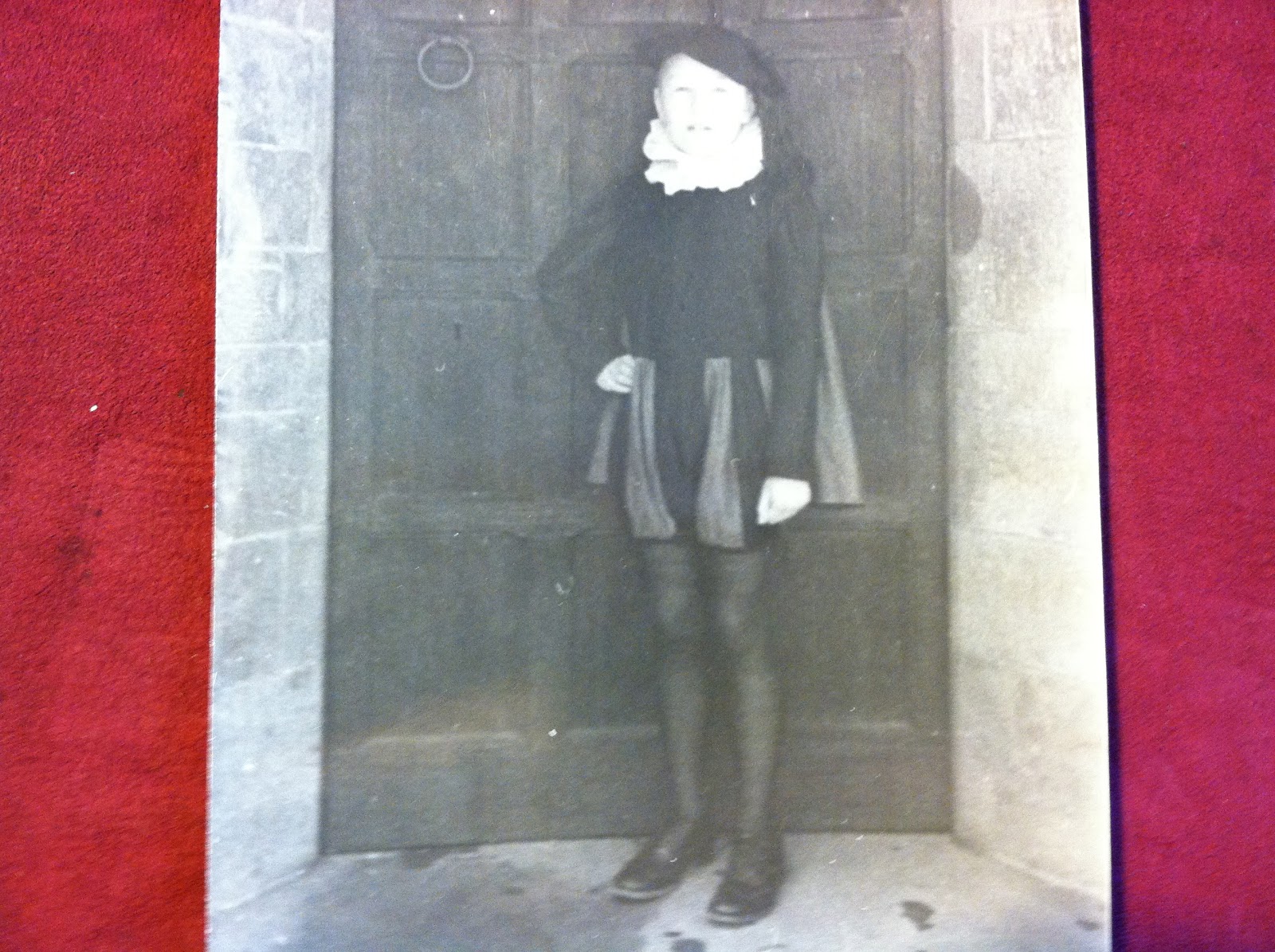
Tradition holds that the Boar's Head festival (Avon Old Farms edition) began during the Pierpont era, but, when I came across this picture last summer, I began to wonder whether the Founder's era also featured Boar's Head.  The picture is from the thirties and this youth would fit in well at a medieval feast.  On the other hand, the Avon Weekly News-letter, which leaves no stone unturned in describing life at school in the mid-thirties, makes no mention of Boar's Head.  So I spoke to Carol Ketcham, the school archivist, who was able to confirm that the first Boar's Head took place in the mid-fifties.  This youth might have been having his picture taken before a church pageant or perhaps a theater production in the refectory, but he was not headed for Boar's Head.
Aspiration and Perseverance, the history by Gordon Clark Ramsey, has the notes from the 1964 Boar's Head, and it looks as though very little has changed in the last 45 years.  We still start with the Jester yelling "Make Way!" and finish - after St. George has vanquished the dragon - by singing "Auld Lang Syne." Most of the things in between - including many of the Jester's lines and songs we sing - remain unchanged.  One thing that has changed is the musical entertainment.  In 1964, and into the 80s, Brad Mason, a veteran of Broadway who held a variety of teaching and administrative posts (including directing Boar's Head), sang "O Holy Night" as a solo.   Now, of course, we have the Riddlers, who offer a couple of musical interludes.  Nonetheless, it is clear that any of the 1964 cast members would have been able to play his role again in 2011 without much of an adjustment.

Friday, December 2, 2011

Footsteps - a personal aside

Yet another reminder this morning that I am following in my grandfather's footsteps.  I am in Virginia for a meeting of the College Board's Academic Advisory Council, and this morning V.P. Jim Montoya spoke briefly about the Board's history.  I had not looked it up, but I had been wondering when the College Board came to be; the Avon Weekly News-letter makes frequent references to Grandpa's consulting on College Entrance Exams.  I had wondered if Grandpa was working with the College Board (the full name of the Board is the College Entrance Examination Board), but I did not know whether it existed in those days.  Jim's brief history tells me that it did, and I am now relatively sure that this - my service to the College Board - is yet another way in which I am following in Grandpa's footsteps.
Of course, there are plenty of things to remind me of the family legacy at school; every visit to Brown Auditorium takes me by a picture of Dad, and the old board room, where I attend meetings at least weekly, contains a photo of Grandpa entertaining several students near the fireplace in his house in Diogenes (now the Lampe residence).  Still, I sometimes get an odd, not-exactly-deja-vu feeling when I discover another one of these connections.  If papers in his Islesboro study are any indication, Grandpa was a big Abe Lincoln fan - another thing we have in common.  I did not really know Grandpa, but I think of him as a taciturn man in the style of Calvin Coolidge; perhaps that is how I come by my dynamic social style.
So there is a bowtie-wearing Custer in the history department at Avon Old Farms, and he does quite a bit of volunteer work with the College Board?  The more things change, the more they stay the same.

Thursday, November 24, 2011

Thanksgiving At Avon

These days, this time of year brings a 10 day vacation, with the boys heading for home after classes on the Friday before Thanksgiving.  It is a welcome respite after a long fall of work.  In the founder's era, though, Thanksgiving brought ONE day off - and even that day was not entirely off.  Instead of students' going home, parents came to school for the holiday.  The boys would play the last football games of the season in the morning - in '35, the Senior Eagles and Junior Diogenes won the day - before everyone, parents and even alumni included - went to the refectory for a traditional turkey dinner, "such as only Mr. Candels can make and serve."  After the meal and a brief speech by Dr. Kammerer, many of the parents went to the provost's house to meet Mrs. Riddle before taking their sons off campus for the afternoon and evening.  There was no study hall, but everyone was due back for the regular weekday lights out.
The Thanksgiving ('35) Issue of the Avon Weekly News-letter reports that the boys doing community service at Hill-Stead that fall had learned a great deal about preparing for Thanksgiving.  They had cut, brought in, husked, and shelled the corn ("What they haven't learned about corn harvesting just isn't there to learn"), and they had picked and sorted the apples for cider.  This was on top of the usual Hill-Stead chores of milking and caring for the cows, pigs, and sheep, etc.
This fall, by the way, Avon students have returned to Hill-Stead.  They are not going over to do farm chores, of course, but they are taking advantage of the farm work others are doing.  Graham Callaghan takes a group over on Sundays to visit the Farmers' Market that Hill-Stead hosts.

Sunday, October 30, 2011

Frogs & Other Updates

from the May 14, 1935 News-letter:  Miscellany - Frogs: Sunday in a rickety, leaky old punt that sunk four times beneath him, Lindberg had the good fortune to catch 4 magnificent, arrogant  bullfrogs at Lower Walton pond with a pitchfork, and their legs were eaten with relish that evening at supper.
& on May 28th, under Science Department: Turtle: On the road to the island yesterday at about 5:00 P.M. Lindeberg picked up a snapping turtle about 15 inches long ... Which reminds us that the last time Verne severed a turtle's head, the said head, after it had been severed, seized and killed a hen who thought dead heads couldn't bite.  (This is really so; see Verne about it.)

I've said it before: one of the most striking things about the Founder's Era is the extraordinary number and diversity of animals Avonians encountered (and potentially ate).  Lest you think the above notes uncommon, I'll assure you the Weekly News-letter contains other references to frog-eating, and the rabbitry is mentioned frequently as well.

I have now finished reading the Weekly News-letter for the '34-'35 school year, leaving only '35-'36 to go.  Once I have finished that tome, I will try to set up an interview with the author.  I hope he has time; just last week he was leading the OWS folks in a stirring rendition of We Shall Overcome in Columbus Circle.  Still vital at 92!

Also, a practical matter.  It seems a number of factors suggest a change in the camera I use to record my interviews.  (The recordings will go to the school's archives when, if ever, I am finished with them.)  Thus, it may be a few weeks before the next interview.

Sunday, September 25, 2011

Stop That Crow!

Spencer Grey '45 is in with the first submission to www.avonoldfarms.com/history.  He remembers Bill Kegley fondly.  At one point, Spencer and some friends were invited to tea at Hill-Stead; "Bill Kegley drove us to Hillstead, and as we approached the front door, the butler was waiting for us in full livery. Bill said we should jump out of the car as fast as possible so that the butler would not have time to open the car door for us." If Kegley was a wee bit mischievous on that occasion, though, he was very thoughtful on another.  Mrs Riddle refused to come to Commencement in 1944 (remember the faculty had retired en masse and the school would soon be closing), but she sat in her car on Dio Circle during the event.  Bill Kegley rounded up as many students as he could and instructed them to go out to the car and say goodbye.  "It was a sad and moving occasion," Grey recalls. 
Grey also remembers keeping a fire lit under a cauldron in the water tower so as to make maple syrup, getting to go upstairs and look at model trains rather than remaining at the formal tea at Hill-Stead, an obstacle course beyond the bank (now Headmaster's Office), and the change in evening dress code that he thinks doomed Provost Brooks Stabler.  He remembers faculty members Dr. Knowles and Mr. Thayer (was he known as Pop?) fondly.
He also tells the story of a friend from the Berkshires who returned from Spring Break with a pet crow, which then lived outside his dorm window.  In those days there was a Sunday tea at the Provost's house, and in good weather it was held outside on the terrace.  It seems that on one of these occasions, the pet crow swooped out of the sky and made off with Mrs. Stabler's silver sugar tongs, which were never seen again!


Monday, September 5, 2011

Alice Makes the Avon List

The April 23, 1935 edition of the Avon Weekly News-letter, put together by friends while Pete Seeger was recuperating from whooping cough, lists those who had made the honor lists for the third quarter.   Reed Estabrook, future Chairman of the Board, made the Dean's List, while Tom Custer, "Pete" Hart, Pete Seeger, and Alice Sperry made the "Avon List."  Wait...Alice Sperry?!
Alice was the daughter of science teacher Holland Sperry, and it seems she at least was allowed to attended Avon - presumably as a day student.  I have seen Alice's transcript, but I have yet to come across evidence of any other girls among the Men of Avon.  It would have been limited, one assumes, to the daughters of faculty members - perhaps to the exclusion of one little girl who offended TPR by announcing that she liked to "play Mrs. Riddle."
The same issue of the News-letter contains a notice about "Police" Court.  It seems Police Court was a separate entity from Summary Court, in that "minor offenders can be brought before it by an officer of the Village who has 'police' powers."  On the prior Friday evening, Judge Wickes heard eight cases, six of them involving "walking on the lawns contrary to the regulations of the Commissioner of Grounds, who is empowered by the ordinance of the Council to make such rules."  The six miscreants were all convicted and sentenced to between two and four hours of hard labor.  The other two offenders were charged with failure to be in bed after ten, one of them having "played his radio."  The News-letter did not report their sentences, if any.

Thursday, July 7, 2011

The Political Process

In the Founder's Era, the student government was very active.  Indeed, the student government levied taxes on the students, and, as you might expect, said taxes were frequently a topic of discussion at Town Meetings.  In the February, '35 Town Meeting, one enterprising student asked why the faculty was not also taxed (it turns out the students lacked the authority to tax the faculty).  Next came a question about a luxury tax on victrolas and crystal sets, with one student pointing out that crystal sets did not use electricity as radios did.  This led to a discussion of the purpose of the taxes and the uses to which the collected funds were put.  The Avon Weekly News-letter's account of the discussion concludes as follows: “It further came out in the discussion that some of the radio license fees was used for restocking the streams on the estate with fish, which prompted Grisom Bettle to spout the following surprising bit: ‘What if the boys with radios and crystal sets don’t like to eat fish?‘  Frankly, no one knew."   

Monday, March 21, 2011

Milestone of Sorts

So I have completed the draft of "The Founder and Her Era," which takes the history of the school through its closing in '44 and TPR's death in '46.  The central story of the chapter in its present form is (once the school opened) the turmoil between TPR and the people she hired to run the school, and it poses the question "Was TPR an eccentric, meddling founder whose interference nearly drove her school to ruin?"  As is suggested in the last post, my answer is no - I think she was eccentric to a degree, and she definitely wanted to have a say in the operation of her school, but I think people finding that unusual or offensive is more sexist than anything else.
The draft is just over 7,200 words, which suggests to me that The History Press word window of 40-45,000 is probably pretty close.  My guess is that the final version of the chapter will be close to 10,000 words, and chapters on the Pierpont, Trautman, and LaRocque eras will be similar in length.  I have not yet decided what to do with the Old Farms Convalescent Hospital, but there seems to be plenty of material, and certainly that chapter would be significantly shorter.
The reason I think there are another 2,800 words coming for "The Founder and Her Era" is that there is much that is still missing.  I have not yet really thought - or consulted with others - about what needs to be in the chapter, but the current draft, for example, does not mention the Nimrod Club, and it only briefly mentions Verne Priest, the Maine woodsman who help manage the woods on the estate.  To this point, I think only two students are mentioned.  I have not yet formally interviewed anyone, and I have not even finished going through the Weekly News-letter.  Thus, there is a wealth of information about the students and the goings-on of the Founder's Era that I'll have to weave into future drafts.
It is important to me that I do a good job with this period, as the next school historian, working perhaps on the centennial in 2027, will not have the access I do to living memories of the era.  (To a lesser but nonetheless still significant extent, the same may be true of the Pierpont years.)
It does feel good to have reached a milestone of sorts; now at least the "book" is not entirely theoretical.