The February 4th, 1936 issue of The Avon Weekly News-letter reminds us that student government really did some governing in the Founder's era. The issue of the day was lateness and the Village Council's standing rule that more than ten latenesses in a week would mean the entire school must check in at Sunday breakfast. When the newsletter came out on Tuesday, there were already eleven latenesses that week, and with the annual Mid-Winter Dance scheduled for Saturday night, the boys were hoping to be able to sleep in on Sunday. Commander Hunter saved the day by proposing both that the new boy's lateness be forgiven (he did not yet fully appreciate the rules) and that any further lateness that week be punished with two hours hard labor, thus sparing the rest of the school an early Sunday morning.
The News-letter also reported on the Town Meeting held the previous Friday. The Village Treasurer, Thomas Custer '36, reported that there was $231.35 in the treasury, which meant that, in the absence of a spike in breakage, there might be a general tax reduction. Also making a report was Village Attorney Reed Estabrook '36, who would go on to spend decades as Chairman of the Board of Directors.
One student suggested the Council appoint a commission to study the problem of tent caterpillars on the Estate and how best to exterminate them. A resolution to that effect passed unanimously, and William Whitney '36, the Warden, expressed his approval, as the solution to the tent caterpillar problem might well present an opportunity for "hard labor" to be assigned to any future late-comers.
Also in the news that week: the boys had seen a movie about - and demonstration of - "seeing eye" dogs, the "Avon List" had been published, and it included both A. Sperry and M.L. Sperry (noteworthy in that they are science teacher Holland Sperry's two daughters Alice and Mary Lou), the Eagles and Diogenes teams had split a pair of recent hockey games, and the Thursday night fire drill was pronounced a success overall, despite a general lack of surprise.
-Theodate Pope RiddleThere should be some oases in this country where the love of tradition is fostered. Avon shall be one of these oases where, when Avonians return, they will find at least a semblance of permanence.
Sunday, February 5, 2012
Sunday, January 29, 2012
Radio Silence
A little over a year ago, when I mentioned this project to a colleague from another school, he was quick to say - in the headmaster's presence - that the school should provide a sabbatical so I can complete it. While I certainly never expected (or really wanted) a sabbatical, I am beginning to see his point. It has been too long since I last made any real headway. It has been a hectic year at school to this point. The "Excellence in Teaching" initiative has gained some traction, but it has consumed time at a hefty clip. (This is an initiative that puts a focus on excellence in classroom teaching; one aspect is a conscious effort to provide teachers with more specific, more meaningful feedback on their teaching, which, of course, takes time.) Exams are under way, with grades and comments due soon, and a conference in Boston beginning tomorrow night. Thus, I do not anticipate doing much on this project for another week or ten days.
After that, I hope to get back to conducting interviews and taking notes on the interviews I've already conducted. So stay tuned; I haven't forgotten, and I hope to break the radio silence again soon with some interesting tidbits of Avon history.
Sunday, December 18, 2011
Boar's Head
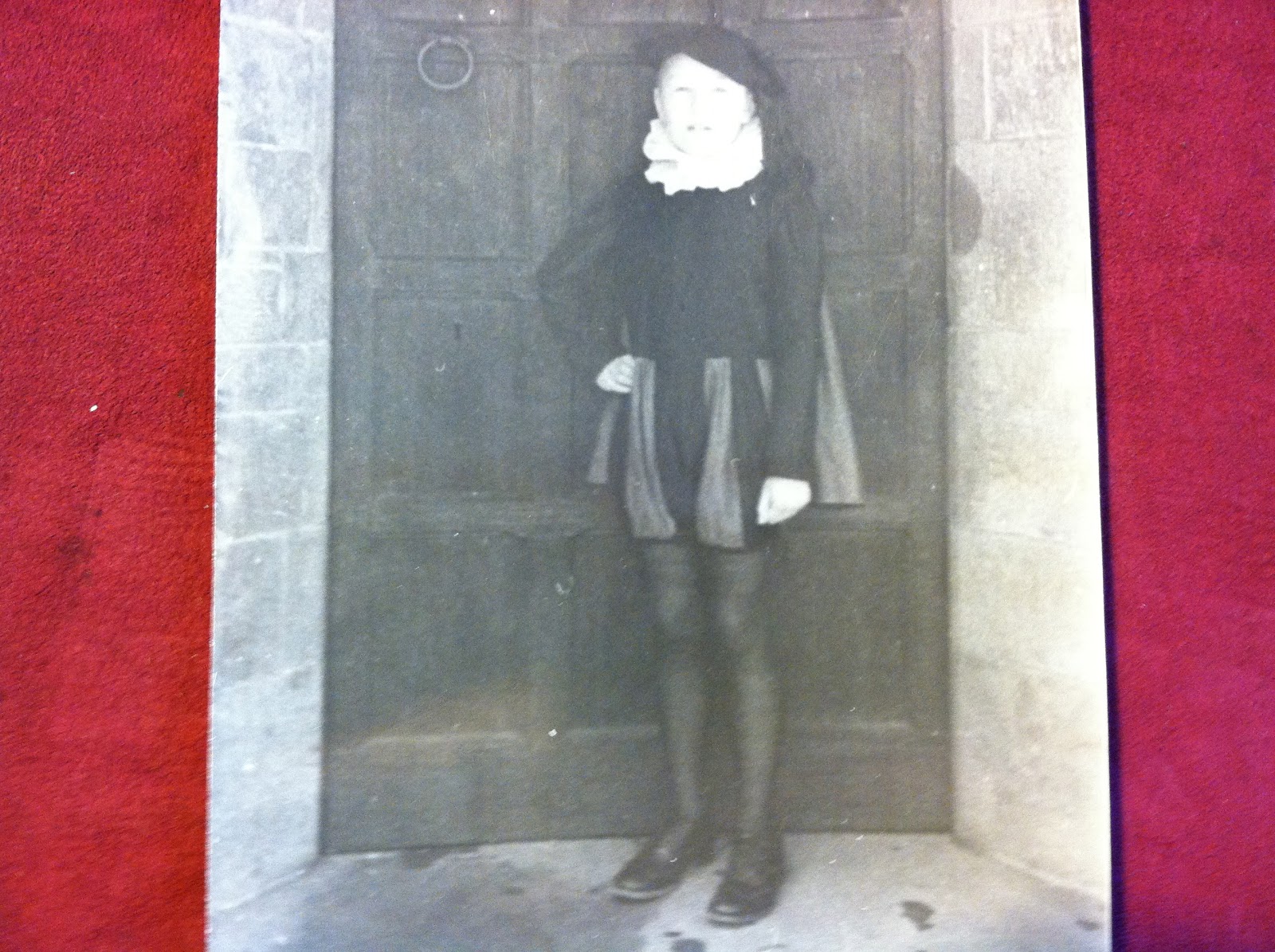
Tradition holds that the Boar's Head festival (Avon Old Farms edition) began during the Pierpont era, but, when I came across this picture last summer, I began to wonder whether the Founder's era also featured Boar's Head. The picture is from the thirties and this youth would fit in well at a medieval feast. On the other hand, the Avon Weekly News-letter, which leaves no stone unturned in describing life at school in the mid-thirties, makes no mention of Boar's Head. So I spoke to Carol Ketcham, the school archivist, who was able to confirm that the first Boar's Head took place in the mid-fifties. This youth might have been having his picture taken before a church pageant or perhaps a theater production in the refectory, but he was not headed for Boar's Head.
Aspiration and Perseverance, the history by Gordon Clark Ramsey, has the notes from the 1964 Boar's Head, and it looks as though very little has changed in the last 45 years. We still start with the Jester yelling "Make Way!" and finish - after St. George has vanquished the dragon - by singing "Auld Lang Syne." Most of the things in between - including many of the Jester's lines and songs we sing - remain unchanged. One thing that has changed is the musical entertainment. In 1964, and into the 80s, Brad Mason, a veteran of Broadway who held a variety of teaching and administrative posts (including directing Boar's Head), sang "O Holy Night" as a solo. Now, of course, we have the Riddlers, who offer a couple of musical interludes. Nonetheless, it is clear that any of the 1964 cast members would have been able to play his role again in 2011 without much of an adjustment.
Friday, December 2, 2011
Footsteps - a personal aside
Yet another reminder this morning that I am following in my grandfather's footsteps. I am in Virginia for a meeting of the College Board's Academic Advisory Council, and this morning V.P. Jim Montoya spoke briefly about the Board's history. I had not looked it up, but I had been wondering when the College Board came to be; the Avon Weekly News-letter makes frequent references to Grandpa's consulting on College Entrance Exams. I had wondered if Grandpa was working with the College Board (the full name of the Board is the College Entrance Examination Board), but I did not know whether it existed in those days. Jim's brief history tells me that it did, and I am now relatively sure that this - my service to the College Board - is yet another way in which I am following in Grandpa's footsteps.
Of course, there are plenty of things to remind me of the family legacy at school; every visit to Brown Auditorium takes me by a picture of Dad, and the old board room, where I attend meetings at least weekly, contains a photo of Grandpa entertaining several students near the fireplace in his house in Diogenes (now the Lampe residence). Still, I sometimes get an odd, not-exactly-deja-vu feeling when I discover another one of these connections. If papers in his Islesboro study are any indication, Grandpa was a big Abe Lincoln fan - another thing we have in common. I did not really know Grandpa, but I think of him as a taciturn man in the style of Calvin Coolidge; perhaps that is how I come by my dynamic social style.
So there is a bowtie-wearing Custer in the history department at Avon Old Farms, and he does quite a bit of volunteer work with the College Board? The more things change, the more they stay the same.
Of course, there are plenty of things to remind me of the family legacy at school; every visit to Brown Auditorium takes me by a picture of Dad, and the old board room, where I attend meetings at least weekly, contains a photo of Grandpa entertaining several students near the fireplace in his house in Diogenes (now the Lampe residence). Still, I sometimes get an odd, not-exactly-deja-vu feeling when I discover another one of these connections. If papers in his Islesboro study are any indication, Grandpa was a big Abe Lincoln fan - another thing we have in common. I did not really know Grandpa, but I think of him as a taciturn man in the style of Calvin Coolidge; perhaps that is how I come by my dynamic social style.
So there is a bowtie-wearing Custer in the history department at Avon Old Farms, and he does quite a bit of volunteer work with the College Board? The more things change, the more they stay the same.
Thursday, November 24, 2011
Thanksgiving At Avon
These days, this time of year brings a 10 day vacation, with the boys heading for home after classes on the Friday before Thanksgiving. It is a welcome respite after a long fall of work. In the founder's era, though, Thanksgiving brought ONE day off - and even that day was not entirely off. Instead of students' going home, parents came to school for the holiday. The boys would play the last football games of the season in the morning - in '35, the Senior Eagles and Junior Diogenes won the day - before everyone, parents and even alumni included - went to the refectory for a traditional turkey dinner, "such as only Mr. Candels can make and serve." After the meal and a brief speech by Dr. Kammerer, many of the parents went to the provost's house to meet Mrs. Riddle before taking their sons off campus for the afternoon and evening. There was no study hall, but everyone was due back for the regular weekday lights out.
The Thanksgiving ('35) Issue of the Avon Weekly News-letter reports that the boys doing community service at Hill-Stead that fall had learned a great deal about preparing for Thanksgiving. They had cut, brought in, husked, and shelled the corn ("What they haven't learned about corn harvesting just isn't there to learn"), and they had picked and sorted the apples for cider. This was on top of the usual Hill-Stead chores of milking and caring for the cows, pigs, and sheep, etc.
This fall, by the way, Avon students have returned to Hill-Stead. They are not going over to do farm chores, of course, but they are taking advantage of the farm work others are doing. Graham Callaghan takes a group over on Sundays to visit the Farmers' Market that Hill-Stead hosts.
The Thanksgiving ('35) Issue of the Avon Weekly News-letter reports that the boys doing community service at Hill-Stead that fall had learned a great deal about preparing for Thanksgiving. They had cut, brought in, husked, and shelled the corn ("What they haven't learned about corn harvesting just isn't there to learn"), and they had picked and sorted the apples for cider. This was on top of the usual Hill-Stead chores of milking and caring for the cows, pigs, and sheep, etc.
This fall, by the way, Avon students have returned to Hill-Stead. They are not going over to do farm chores, of course, but they are taking advantage of the farm work others are doing. Graham Callaghan takes a group over on Sundays to visit the Farmers' Market that Hill-Stead hosts.
Sunday, October 30, 2011
Frogs & Other Updates
from the May 14, 1935 News-letter: Miscellany - Frogs: Sunday in a rickety, leaky old punt that sunk four times beneath him, Lindberg had the good fortune to catch 4 magnificent, arrogant bullfrogs at Lower Walton pond with a pitchfork, and their legs were eaten with relish that evening at supper.
& on May 28th, under Science Department: Turtle: On the road to the island yesterday at about 5:00 P.M. Lindeberg picked up a snapping turtle about 15 inches long ... Which reminds us that the last time Verne severed a turtle's head, the said head, after it had been severed, seized and killed a hen who thought dead heads couldn't bite. (This is really so; see Verne about it.)
I've said it before: one of the most striking things about the Founder's Era is the extraordinary number and diversity of animals Avonians encountered (and potentially ate). Lest you think the above notes uncommon, I'll assure you the Weekly News-letter contains other references to frog-eating, and the rabbitry is mentioned frequently as well.
I have now finished reading the Weekly News-letter for the '34-'35 school year, leaving only '35-'36 to go. Once I have finished that tome, I will try to set up an interview with the author. I hope he has time; just last week he was leading the OWS folks in a stirring rendition of We Shall Overcome in Columbus Circle. Still vital at 92!
Also, a practical matter. It seems a number of factors suggest a change in the camera I use to record my interviews. (The recordings will go to the school's archives when, if ever, I am finished with them.) Thus, it may be a few weeks before the next interview.
& on May 28th, under Science Department: Turtle: On the road to the island yesterday at about 5:00 P.M. Lindeberg picked up a snapping turtle about 15 inches long ... Which reminds us that the last time Verne severed a turtle's head, the said head, after it had been severed, seized and killed a hen who thought dead heads couldn't bite. (This is really so; see Verne about it.)
I've said it before: one of the most striking things about the Founder's Era is the extraordinary number and diversity of animals Avonians encountered (and potentially ate). Lest you think the above notes uncommon, I'll assure you the Weekly News-letter contains other references to frog-eating, and the rabbitry is mentioned frequently as well.
I have now finished reading the Weekly News-letter for the '34-'35 school year, leaving only '35-'36 to go. Once I have finished that tome, I will try to set up an interview with the author. I hope he has time; just last week he was leading the OWS folks in a stirring rendition of We Shall Overcome in Columbus Circle. Still vital at 92!
Also, a practical matter. It seems a number of factors suggest a change in the camera I use to record my interviews. (The recordings will go to the school's archives when, if ever, I am finished with them.) Thus, it may be a few weeks before the next interview.
Sunday, September 25, 2011
Stop That Crow!
Spencer Grey '45 is in with the first submission to www.avonoldfarms.com/history. He remembers Bill Kegley fondly. At one point, Spencer and some friends were invited to tea at Hill-Stead; "Bill Kegley drove us to Hillstead, and as we approached the front door, the butler was waiting for us in full livery. Bill said we should jump out of the car as fast as possible so that the butler would not have time to open the car door for us." If Kegley was a wee bit mischievous on that occasion, though, he was very thoughtful on another. Mrs Riddle refused to come to Commencement in 1944 (remember the faculty had retired en masse and the school would soon be closing), but she sat in her car on Dio Circle during the event. Bill Kegley rounded up as many students as he could and instructed them to go out to the car and say goodbye. "It was a sad and moving occasion," Grey recalls.
Grey also remembers keeping a fire lit under a cauldron in the water tower so as to make maple syrup, getting to go upstairs and look at model trains rather than remaining at the formal tea at Hill-Stead, an obstacle course beyond the bank (now Headmaster's Office), and the change in evening dress code that he thinks doomed Provost Brooks Stabler. He remembers faculty members Dr. Knowles and Mr. Thayer (was he known as Pop?) fondly.
He also tells the story of a friend from the Berkshires who returned from Spring Break with a pet crow, which then lived outside his dorm window. In those days there was a Sunday tea at the Provost's house, and in good weather it was held outside on the terrace. It seems that on one of these occasions, the pet crow swooped out of the sky and made off with Mrs. Stabler's silver sugar tongs, which were never seen again!
Grey also remembers keeping a fire lit under a cauldron in the water tower so as to make maple syrup, getting to go upstairs and look at model trains rather than remaining at the formal tea at Hill-Stead, an obstacle course beyond the bank (now Headmaster's Office), and the change in evening dress code that he thinks doomed Provost Brooks Stabler. He remembers faculty members Dr. Knowles and Mr. Thayer (was he known as Pop?) fondly.
He also tells the story of a friend from the Berkshires who returned from Spring Break with a pet crow, which then lived outside his dorm window. In those days there was a Sunday tea at the Provost's house, and in good weather it was held outside on the terrace. It seems that on one of these occasions, the pet crow swooped out of the sky and made off with Mrs. Stabler's silver sugar tongs, which were never seen again!
Subscribe to:
Posts (Atom)