Thursday, October 17, 2013
"Men of Avon" Video
Earlier this fall, Bryan Zaros, our director of choral activities, put together this video to celebrate the history of "Men of Avon." If you have not yet seen it, do take a look. Thanks to Bryan, his choral groups, Archivist Carol Ketcham, and everyone else who had a hand in this video.


Sunday, October 6, 2013
Don Pierpont Saved My Life
On the occasion of the sixty-fifth anniversary of the school's re-opening and the forty-fifth anniversary of Don Pierpont's death, Pierpont-era alumni gathered on campus this weekend to remember their Provost at a dinner and fireside chat on Friday evening and a Chapel service on Saturday morning. At both events, participants stood up and spoke about their particular memories of "Pierps."
There were, frankly, tears shed in both the Commons Room (Friday evening) and the Chapel as alumnus after alumnus recounted the profoundly positive impact that Don Pierpont had on their lives. Many stories followed the same outline: confronted with a vulnerable, unsuccessful, perhaps misbehaving boy or young man, Pierpont somehow saw potential no one else could recognize, provided a second (or more) chance and then helped the young lad find - and believe in - his best self. Pierpont's legendary compassion was on full display, perhaps best in the story of a meeting between Pierpont, a student, and Dean Kincaid. The dean pointed out that the student was failing most of his classes, had been drinking in the dorm, and had recently stolen Pierpont's car! Pierps's response? "Don't confuse me with facts"! That student stayed at Avon, graduated, and is grateful to Don Pierpont for the happy life he has enjoyed since then.
Of course, as with any gathering at which Don Pierpont is remembered, there were repeated references to Ho Jo's!
.JPG) |
| The Chapel Ready for the Don Pierpont Service |
Of course, as with any gathering at which Don Pierpont is remembered, there were repeated references to Ho Jo's!
Friday, October 4, 2013
Who Was Mrs. Riddle?
Anyone who seeks to understand - let alone write about - the history of the school has to wrestle with the question of who Mrs. Riddle really was. We know the basics, of course: daughter of Alfred A. Pope, graduate of Miss Porter's, first registered female architect in Connecticut, Lusitania survivor, and founder of Avon Old Farms. We know that she had a reputation for eccentricity writ large. We know that she was, to put it mildly, strong-willed. We also know that these attributes have been caricatured in a series of popular myths/exaggerations about Mrs. Riddle. (She did not, for example, choose Percy Kammerer as Provost simply by finding his name in a telephone directory, and she did not have a roof torn down simply because it did not sag correctly.) The questions we confront are: how eccentric and strong-willed was she, and to what extent was she to blame for the departures of three Provosts and two entire faculties during the Founder's Era?
Certainly, there was a widespread perception at the time that TPR could be difficult to work with. Cal Magruder '46, for example, recalls that most of the faculty and most of the students sided with Provost Stabler rather than TPR in the conflict that would lead to his departure and the school closing. Time magazine chose to highlight the founder's eccentricities (and her progressive views on education) in their March, 1944 article on the closing. They no doubt enjoyed using the word "warped" to describe the sag in Avon's roofs and "Warped to Order" as a sub-heading for that section of the article. However, Time also chose to perpetuate the phone directory myth and suggested that Francis Froelicher and Percy Kammerer had "quit" after "rows," presumably with TPR. The reality is that neither of them had "quit" and that both had been guilty of behavior unbecoming of a provost and potentially damaging to the school.
Eddy Custer '43 was an exception to Cal Magruder's rule. He wrote his brother Tom ('36) that he has "always thought Mrs. Riddle was wonderful and Stabler horrible," but went on to quote his mother, the history teacher John S. Custer's wife, as referring to TPR as "a spoiled and ruthless old woman"! "Mother said Mrs. Riddle had imposed conditions under which Mr. Stabler could not possibly stay, but she didn't say what the conditions were." Frankly, it is hard to imagine. Provost Stabler had already instituted religious services at school - appointing himself "Rector" - and changed the name of the school. It is not as thought TPR never let him take the initiative. Would that Eddy (Dad) or my grandparents were still around to shed some light on the subject.
As I get closer to being "finished" with my chapter on the Founder's Era (long-time readers will know that I have already both a) claimed to have completed such a draft and b) observe that "finished" is not a word one can ever truly apply to history), I am confronted with the necessity to address these questions. At the moment, I am inclined to conclude that a healthy measure of the anti-TPR sentiment of the day stemmed more from the biases of the day than from her own, admittedly quite real, idiosyncrasies. Once I have organized my thinking and taken a stab at the conclusion of this chapter, I'll write another post on this issue. In the meantime, do share any thoughts or understanding you may have!
 |
| Theodate Pope Riddle |
Certainly, there was a widespread perception at the time that TPR could be difficult to work with. Cal Magruder '46, for example, recalls that most of the faculty and most of the students sided with Provost Stabler rather than TPR in the conflict that would lead to his departure and the school closing. Time magazine chose to highlight the founder's eccentricities (and her progressive views on education) in their March, 1944 article on the closing. They no doubt enjoyed using the word "warped" to describe the sag in Avon's roofs and "Warped to Order" as a sub-heading for that section of the article. However, Time also chose to perpetuate the phone directory myth and suggested that Francis Froelicher and Percy Kammerer had "quit" after "rows," presumably with TPR. The reality is that neither of them had "quit" and that both had been guilty of behavior unbecoming of a provost and potentially damaging to the school.
Eddy Custer '43 was an exception to Cal Magruder's rule. He wrote his brother Tom ('36) that he has "always thought Mrs. Riddle was wonderful and Stabler horrible," but went on to quote his mother, the history teacher John S. Custer's wife, as referring to TPR as "a spoiled and ruthless old woman"! "Mother said Mrs. Riddle had imposed conditions under which Mr. Stabler could not possibly stay, but she didn't say what the conditions were." Frankly, it is hard to imagine. Provost Stabler had already instituted religious services at school - appointing himself "Rector" - and changed the name of the school. It is not as thought TPR never let him take the initiative. Would that Eddy (Dad) or my grandparents were still around to shed some light on the subject.
As I get closer to being "finished" with my chapter on the Founder's Era (long-time readers will know that I have already both a) claimed to have completed such a draft and b) observe that "finished" is not a word one can ever truly apply to history), I am confronted with the necessity to address these questions. At the moment, I am inclined to conclude that a healthy measure of the anti-TPR sentiment of the day stemmed more from the biases of the day than from her own, admittedly quite real, idiosyncrasies. Once I have organized my thinking and taken a stab at the conclusion of this chapter, I'll write another post on this issue. In the meantime, do share any thoughts or understanding you may have!
Thursday, September 19, 2013
Letters From India
My father, Eddy Custer '43, joined the American Field Service immediately after graduation and spent a year serving in India as an ambulance driver and company clerk. Throughout his travels, he wrote lengthy letters to his parents and to his older brother Tom (AOF '36). Tom's daughter Barbara recently came across a cache of these letters and sent them to my brother. In many ways, these letters are typical of any young man off to war - filled with yearning for home, affection for loved ones, stories of the wonders and the tedium of travel and then service, and constant entreaties to write letters.
For some reason, it had not occurred to me until I read these letters that the "home" for which Dad was pining as he started his journey would be gone by the time he returned. In the fall of '43, there was no inkling that Avon would not go on forever, and he mentions the excellence of the fare in the Refectory and Chef Candles' magnificent Thanksgiving feast among the many things he missed.
By the time Dad returned from India, the school would be closed, and his parents would no longer live in the Diogenes apartment where he grew up. He learned of the school's fate in a March, 1944 TIME Magazine article. In May, he wrote "I still can't believe Avon is closing. It seems like a fantastic nightmare." Later in the month: "I disagree with you that there are other places in this world equally nice. Any school after Avon will seem grim to me..."
 |
| This embroidered seal accompanied the letters |
By the time Dad returned from India, the school would be closed, and his parents would no longer live in the Diogenes apartment where he grew up. He learned of the school's fate in a March, 1944 TIME Magazine article. In May, he wrote "I still can't believe Avon is closing. It seems like a fantastic nightmare." Later in the month: "I disagree with you that there are other places in this world equally nice. Any school after Avon will seem grim to me..."
Thursday, July 18, 2013
Back to the Future: Skip Flanagan Part I
A few years ago, Henry "Skip" Flanagan re-joined the Avon faculty after a 26 year absence durning which he served as headmaster of Western Reserve Academy in Hudson, Ohio. Skip first interviewed for a job in admissions while he was still a graduate student at the University of Michigan. He did not get the admissions job, but he was so taken with the place that he let George Trautman know he was willing to do anything to get his foot in the door. Soon he was moving his family into Pelican dorm and preparing to teach English and French, coach football and lacrosse, and - as the contract used to say - "other duties as assigned." This was in 1972, and the Flanagans would be at Avon until the spring of 1982.
In Skip's second year at Avon, John Green, the dean of students, left to become headmaster at Rectory School in Pomfret, CT, and George asked Skip to step in as dean. (Actually it was John Green who blazed the "dean at Avon - headmaster somewhere else - return to Avon" trail; he spent several years back on campus after retiring as a headmaster.) In those days, dean of students really meant director of college counseling, and Skip has great memories of that work. This was long before the personal computer, so Skip would dictate the boys' college recommendations to Frieda Mason, wife of Brad Mason, who typed as he spoke. They would complete the recommendations for a class of 60-70 seniors during a ten day period in the early fall! Skip particularly remembers the help of Marie Delnicki, who joined the office early in his tenure as dean and who serves as registrar to this day. Marie is one of those multi-talented people who simply make things work.
 |
| Skip Flanagan |
When I pointed out to Skip that he and then dean of faculty Henry Pennell have now been replaced by about half a dozen people each (there are currently five administrators focused entirely on the academic program, four people - including Skip - are involved in college counseling, and three people are largely focused on residential/student life), he replied that the 70s were a simpler time in schools. For example, he recounted simply piling the applicants to Williams College into a van and driving them to Williamstown, where they would be interviewed by the director of admissions, who would then call Skip the next day to discuss the candidates and make his decisions. That is NOT how college admissions works today!
Among the other names Skip remembers fondly from that period were Bill Kron, "the conscience of all things academic," Brad Mason, Frank Leavitt, Courtney Bird, Seth Mendell, "the consummate storyteller," and especially Sid Clark.
Skip's wife Brit Flanagan developed a good friendship with Sid (good judge of character, Brit; she also befriended Wilbur Durfee); Skip remembers returning from dorm duty at night to find Sid playing the piano (Sid's life before Avon included a stint as a professional musician). Interestingly, Skip used the term "gruff facade" to describe both Sid Clark and George Trautman. In Sid's case, he nonetheless became Skip's mentor in the English department and a lifelong friend to both Skip and Brit. In George's case, Skip says behind the gruff facade lay "a lot of caring and a big heart for those who served the school well..." Agreed.
Enough for now. Look for more from our interview in Back to the Future, Part II.
Monday, July 8, 2013
Lunch in Gettysburg
Ben Custer '10 and I are just back from a trip to Gettysburg for the 150th anniversary of the famous battle there. Beyond thwarting a rebel invasion and preserving democracy, our agenda included lunch with Fred Michel '77 at an Irish Pub in town. It was great fun to meet Fred and hear some of his stories of the Trautman era. We also, frankly, spent a great deal of time talking about the Civil War and about the history of Frederick, Maryland, where Fred lives.
I would have more to say about our conversation, but my memory has been obscured by being killed four times in as many days (yes, we spent four days reenacting a three day battle; these things take time), wearing heavy blue wool in the heat of midsummer, and so on. One aspect of the lunch I will not soon forget is Fred's generosity. He had planned to pay for lunch, but our waiter announced that Ben's and my meals had been paid for by the gentlemen at the next table. They had been at the battle that morning or the day before, and they wanted to thank us (as representatives of the reenacting community) for making it possible for them to get a sense of what had happened 150 years earlier. Fred, not to be outdone, gave the folks his card and generously offered to show them around the various points of interest in nearby Frederick. Having spoken with Fred, I know a) that there is a great deal to see in Frederick, Maryland, and b) that Fred's knowledge and enthusiasm for the area make him an ideal tour guide; I do hope the good folks took him up on the offer. In any event, it was a nice display of community/generosity on Fred's part.
 |
| With Ben Custer '10, and Fred Michel '77 |
Thursday, June 20, 2013
Grandparents Day
If you look at the Colombian flag that hangs in the Refectory, you will see the name German Lopez on the plate - this was the first flag added to the Refectory. On Grandparents Day, I got a chance to chat with German, who was on campus visiting his grandson Luis Jaramillo '15. Lopez, known as "Lopey" at the time, was Warden of the class of '49, the first class to graduate after the school re-opened.
As Warden, German had frequent meetings in Don Pierpont's house, and German remembers Pierpont very fondly. Other memories in include making coffee and roasting marshmallows in the working fireplace in his room, being "an item" with Frank Leavitt's older sister Carol (the Leavitt family rented space in the Quad in those days), and meetings of an elite group - was it the Order of Old Farms? - in a room upstairs in the Water Tower. He used to babysit for the Kincaid family and once borrowed their car, fell asleep, and drove it into an apple tree! German says the accident caused no big fuss, which I am inclined to believe given the number of crashing-the-borrowed-faculty-car stories that seem to emanate from the Pierpont years! Apparently German Lopez set the precedent.
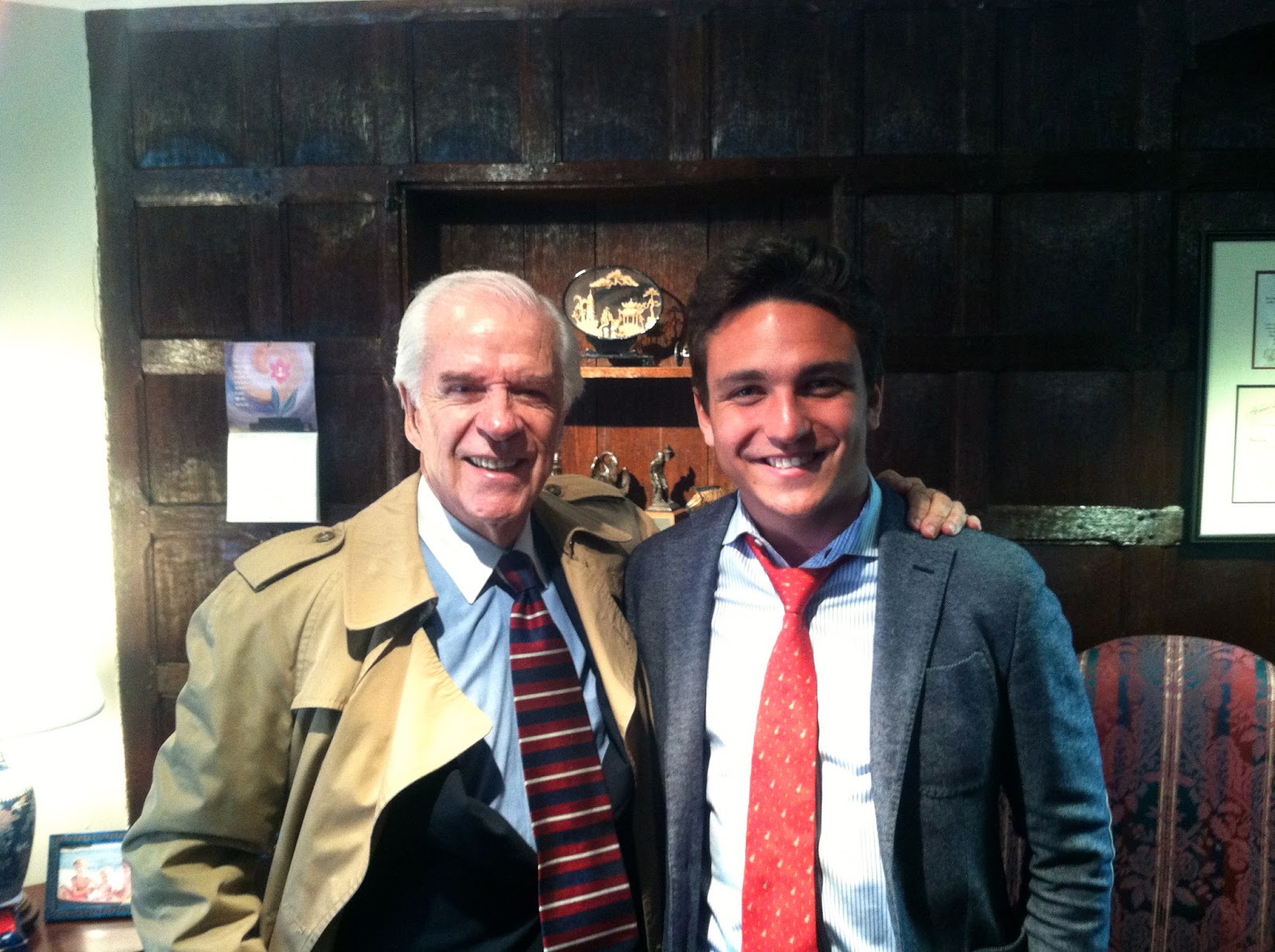 |
| German Lopez '49 & his grandson, Luis Jaramillo '15 |
Subscribe to:
Posts (Atom)