There should be some oases in this country where the love of tradition is fostered. Avon shall be one of these oases where, when Avonians return, they will find at least a semblance of permanence.
-Theodate Pope Riddle

Wednesday, July 1, 2020

"Nails" Trautman, An Appreciation

I remember vividly the first time I saw George Trautman. All of twenty-two and not yet a college graduate, I had arrived on campus to interview for a position teaching history. I passed through Dio archway unsure about where the Headmaster's Office might be. As I pondered what to do next, a solitary figure emerged from Eagle archway, turned left, and walked out of the Quad between Eagle and Elephant. I knew. I do not often follow hunches, I do not act on impulse that much, but I knew: that man was the headmaster.  Short version: It was George; I followed him, found his office, got the job.
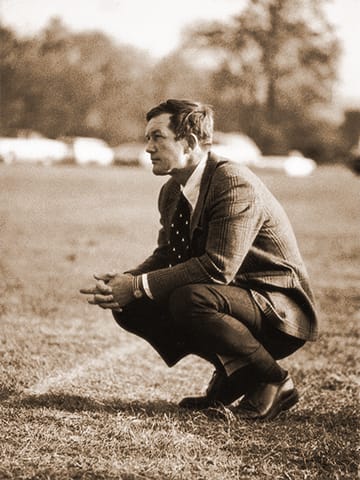
Iconic image of George "Nails" Trautman
The other thing I most remember about that interview is that George opened it by asking what I thought of the man who had been headmaster at the school I attended. That man had fired my father after more than a decade's service to the school, so the question horrified me, but it turned out to be a great icebreaker. George's response to the story both set me at ease in the moment and convinced me that working for George would be nothing like working for the man who had let dad go.
If that story does not make George Trautman sound like a man whose students would nickname him "Nails," consider the story of most students' introduction to their new headmaster. It was the early fall of 1969, and George had written to students during the summer to reinforce the haircut rule. As they arrived on campus, long-haired students found they were not permitted even to drop off luggage in their room before getting the necessary haircut. Registration was in Dio Circle in those days, and Henry Coons '71 - whose hair had passed muster - watched from his room in Dio as the new headmaster loaded students into vans that would take them to a nearby barber shop. It was a risky move, to be sure, but George had set the tone for what turned out to be a twenty-nine year run as headmaster of Avon Old Farms. 
The many, many successes of those twenty-nine years have been and will be chronicled elsewhere; the thing that always struck me about George was his remarkable instincts for this work.  He always seemed to know what questions would lead directly to the heart of the matter and how to respond once he got there.  At times, it almost seemed as though George had a "sixth sense."
On one such occasion, my wife woke me up in the middle of a late spring night to report odd noises emanating from the Quad.  A senior prank, perhaps?  When we looked out the window, we saw some seniors somehow hoisting a canoe up into one of the big trees near Eagle.  I started to get dressed, pondering exactly what I might say to a group of seniors bent on some sort of canoe-tree mischief, when a second look out the window revealed the canoe being being lowered back to the ground.   What had caused the pranksters to change course?  George was standing just inside Eagle Archway staring intently at the proceedings.  If he said anything, I did not hear it, but the boys were quickly about the business of undoing their handiwork and slinking off the bed.  When I asked George later on how he had known what was going on - had he heard noises from the Quad? - he said he was not sure; he woke up and somehow knew that going for a walk was a good idea.
So, "Nails" is a fitting moniker for part of George Trautman's legacy. He had an intimidating physical presence, his handshake would break bones if you were not ready for it, and he could, and would, play hardball. On the other hand, the boys, and the faculty, for that matter, always knew he cared about them. He wanted the best for everyone associated with Avon, and he understood that usually means wanting the best from them as well. For that reason, he could both intimidate you and put you at ease in the same interview. Rest In Peace, Nails.

Tuesday, February 26, 2019

Avon and the War


Recently, our Archivist, Dawn Driggs, left a few things aside for me to look at before she filed them away, and one of them is a pamphlet called Avon and the War. It presents itself as a summary of how the school was responding to the reality of World War II and how it was preparing students for their war-time futures. Of course there were additions to the curriculum, such as "a Pre-Flight Course" and a "Basic Officer's Training Course in Mathematics." There were new topics in old courses, as well. "In History," it says, "the subjects of global geography, the economic and other causes of the war, the mistakes of the last peace ... are among the topics receiving special emphasis."  

Note the name: The Avon School

All of that makes sense, of course, but this paragraph in particular caught my eye: Avon's unusual form of student government has assumed added significance during these war days. The entire school is organized as the Village of Old Farms, with its own law and courts, its own post office and bank, and with a government based on that of the New England township. The Student Council levies taxes, grants charters, floats bond issues, preserves the peace, promotes the public welfare - in fact deals with all everyday concerns outside the academic field. This form of student government is excellent training for citizenship and democracy. By actual contact with civic affairs and the assumption of genuine responsibilities, a boy becomes familiar with the workings of government and with the problems he must understand if later he is to take an active, intelligent interest in the welfare of his own community.

With the exception of the first sentence, this paragraph might have appeared in any Founder's Era school publication. Indeed, in many ways, this paragraph neatly captures Theodate Pope Riddle's progressive approach to education, which called for education by doing - an active approach which today would include making and experiential learning. While it might seem hardly surprising that a school publication would emphasize an educational philosophy dear to TPR's heart, note the name of the school. This was a document published by The Avon School and attributed to W. Brooke Stabler, Rector.

Within a few years, Stabler would resign his position and urge the entire faculty to do the same; when they did, TPR felt she had no choice but to close the school. Within the school community, there were those - my father was one - who felt that the Reverend Mr. Stabler was responsible for the rift with TPR, but the larger group - it included my grandmother - put the blame squarely on Mrs. Riddle. The latter group felt that TPR was meddlesome and overbearing, and that she created conditions under which Mr. Stabler could not be expected to continue - nor could anyone else. I mention all of this because the pamphlet Avon and the War serves as a reminder that Stabler was able to make a number of significant changes at school - including changing the name of the school - which leads me to wonder how tied his hands really were.

Tuesday, February 12, 2019

The Times, They Are A-Changin'

It has been a long time since this blog was truly active; indeed, I've not posted more than twice in a year since 2013. In those few posts, I frequently complain about not having enough time to commit to this project.
Aspirando et Perseverando
That is about to change. Jim Detora, who will become headmaster this summer, has asked me to move to a new role for next year, and the focus of that new role will be ... school history. Anticipating the school's centennial in 2027, I will be working on an updated narrative history of the school and helping to plan and prepare for the various centennial celebrations and events. I will also be spending a great deal of time in the archives, so I will be immersed in school history for many hours a day. Instead of my day job keeping me away from this project, my day job will include this project.
Do not expect the blog to leap back into regular production right away. I need to keep focused on the work I am in at the moment. It is safe to say, though, that there will be a few more posts between now and summer; and then, the work begins.

Monday, January 28, 2019

Heady Times at Avon

Note: I wrote this post in September and then clearly got distracted by my "day job." As the next post will explain, that is about to change!

This morning, Monday the 24th of September, Board of Directors Member Chris Drew '85 announced on behalf of the board the selection of Jim Detora to succeed Ken LaRocque as headmaster. The morning meeting announcement was greeted with thunderous applause from the assembled students, faculty and staff, and Jim spoke briefly and graciously about his vision for Avon Old Farms.

Karen and Jim Detora
I cannot claim to have been an unbiased or dispassionate observer. Jim and I have been colleagues for a quarter of a century, and we have worked closely together during much of that time. When Jim was appointed academic dean (there was only one in those days), I was dean of faculty, and as the only academic administrators we had plenty of occasion to collaborate. Some years later, Jim joined me as co-dean of faculty, and we literally shared a job description. When Jim became the provost (chief academic officer) and I moved to dean of curriculum and instruction, we continued to work closely together. So it is in that context that I say bravo to the search committee; you have chosen wisely.

Of course, this is not the first time the board of directors has been successful selecting the headmaster. The more I study school history, the more I am convinced that each of the three men who have served in that capacity since World War II proved to be exactly what the school needed in that moment. Don Pierpont and George Trautman, though very different in many ways, are both excellent examples of the man and the moment being right for each other. So is Ken LaRocque.

Ken LaRocque
I will wax lyrical about Ken in many a future post, I assume. My point in this one is that Jim Detora's appointment as Ken's successor both invites us to look forward to the future with optimism and allows us to savor the last year of Ken's tenure and to celebrate his accomplishments. Had the board lingered over the selection, or chosen someone less obviously right for the job, we might have spent this school year apprehensively eying the future. As it is, the future has been secured, and we can now spend this year "in the moment" - celebrating the accomplishments of Jim Detora's predecessor.

Thursday, September 20, 2018

Peter Evans

Apparently, I have not posted to this blog in over two years! It is fitting that the last post concerned the first Intersession, because I tend to blame my Day Job for the crickets emanating from this space for so long. It is time to change that, and I will begin with what I fear is the first of many: a tribute to a pillar of the Avon community who has retired/is retiring after many decades at school. There is a cohort of "lifers" that has been slowly moving toward retirement, and the leading edge has arrived at the door. When he retired at the end of last (school) year, Peter Evans took a plunge that more than half a dozen others are likely to take in the next several years, beginning with Ken LaRocque at the end of this school year.

Peter Evans, H '18
Peter Evans was the first faculty member I met when I moved onto campus in the fall of '82. The night before the opening faculty meetings, as the new faculty were moving into our quarters, Pete and Sue made the rounds to greet us and welcome us to Avon. That was typical of Pete and Sue. Pete had a lot of titles at school; master teacher of history, athletic director, director of college counseling, assistant headmaster, and director of development is not an exhaustive list. One of the reasons he excelled in all those roles was that he was a people person, and he was attentive to the little things. Greeting new faculty was not explicitly part of his job description, but he and Sue wanted to be sure we felt welcome.
Pete is brilliant, he is eloquent, and he is meticulous; beyond that, he truly cares. To talk to Pete is to be convinced that you are the only thing in his world in that instant and that your happiness and success are foremost on his mind. That is what colleagues felt when he spoke with us, and that is what students felt. It is easy to listen to a man who clearly genuinely cares about you. If all that is not enough, Pete is relentlessly optimistic. No matter what the situation, count on Pete to identify the positive, or at very least the potential for positive, that comes from it. For almost half a century, Pete applied that signature combination intelligence, planning, optimism and care to All Things Avon Old Farms, and we as a school - and we as people - are infinitely better off because of it.
I will stop there, because, try as I might, I am not really able to capture what Pete (and Sue!) Evans have meant to Avon Old Farms; fortunately, this video does:


Sunday, January 17, 2016

Yea Rah!

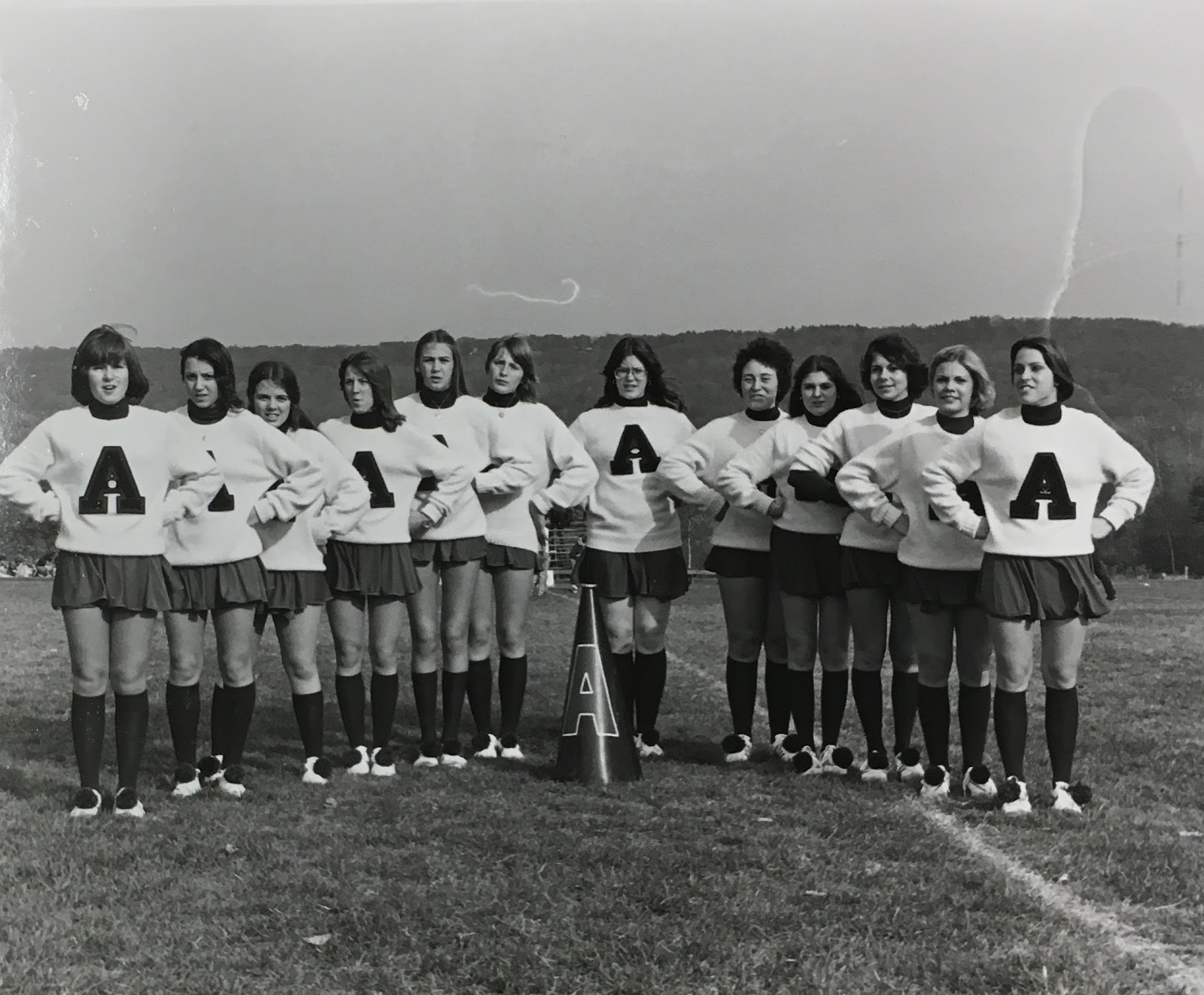
Avon has recently concluded its first "Intersession," a week in which we suspend the normal academic program, and students and faculty devote their attention to only one of thirty non-traditional courses. My own offering was called "Exploring AOF History," and the idea was that students would delve deeply into a particular aspect of school history and create something that might help the school celebrate its centennial. Not surprisingly, the boys chose to investigate the history of sports at Avon. They got to explore the archives, they interviewed two Avon headmasters and several coaches, and they learned about Avon's traditions in polo, fencing, and jiu jitsu. They also discovered this photograph.


We had a lot of fun discussing what the story of this picture might be, but we learned the truth in conversation with Peter Evans and George Trautman. It seems it was part of a mid-seventies effort to drum up school spirit. Some of the boys recruited girls they knew to serve as cheerleaders and create an enthusiastic atmosphere at games. It was a short-lived experiment, but perhaps it worked. Could it have led directly to the  Avon Army?

Sunday, September 27, 2015

Thank You, Reed

This year, George Trautman used his Vespers talk to pay tribute to F. Reed Estabrook '36, who served for many years as Chairman of the Board of Directors. George characterized Reed as "the second most important person" in the history of the school (after TPR), and I doubt there are many who would disagree.
Reed was among those who were instrumental in the re-opening of the school in 1948, and he was the youngest member of the Board at that time. Avon had no money and no endowment in those years, and Reed would prove to be an invaluable counselor to Don Pierpont and then George Trautman as they worked to keep the ship afloat. George noted the incredible growth of the school since '48 and observed that the strong position we now occupy would be part of Reed Estabrook's legacy. Mr. Trautman offered some insight into the relationship between the headmaster and chairman when recalled the story of a student's death on the playing fields. Losing the boy had left George essentially numb, and it was Reed Estabrook who pulled him aside and convinced him he had to keep going.
It was a fitting tribute to a man who gave tirelessly to his school and who would come to campus at the drop of a hat. For some reason, as soon as George began to speak about Reed, I was overwhelmed by the memory of how students enjoyed Reed's accent, especially when, having been introduced by the headmaster at some formal function, Reed would step to the podium and say "Than you, George." I remember more than once walking out of such an assembly behind students endless repeating "Thank you, George" in their best Boston accents.
This year, it was George's turn to say "Thank you, Reed."

Friday, May 1, 2015

Another Snippet About TPR

In late April, I had a first appointment with a new doctor, and it turned out that he had lived for some time in a house that was once part of the Hill-Stead property and had met a number of people with first-hand experience of TPR.  The one anecdote he told comes from TPR's attorney, whom the good doctor got to know well. It seems TPR and her attorney were returning to Hill-Stead in her car when they came upon a couple of town officials who were looking at the sharp turn on Mountain Road near the Hill-Stead entrance.  When TPR stopped to find out what they were up to, they suggested there might be a way to make the turn safer but that it would require that TPR yield a small piece of property.  TPR turned to her attorney and asked "Do I have to do this?"  When he responded that she did not, she turned to the two officials and said simply "no."
So what does this anecdote tell us? I suppose it is encouraging to those inclined to think of TPR as overbearing and difficult to deal with.  Certainly it reinforces the notion that she was strong-willed and decisive, but we knew that already.   We also knew she was eccentric, which raises a number of questions for me.  First is the classic question about TPR and her era: did she somehow drive away three Provosts and two entire faculties and in so doing force her school to close?  Second is what does "eccentric" mean in the context of a strong-willed woman in the early twentieth century?
So what about this idea that TPR was overbearing, perhaps overly meddlesome, and the trials of the Founder's Era were entirely of her own creation?  Certainly there were those in her day who took that view.  Cal Magruder '46 reports that the perception among students in '44 was that the troubles came as result of disputes between TPR and Brooks Stabler, and the faculty and students collectively sided with Stabler.  Of course, like most Founder's Era alumni, Cal also reports he did not see much of TPR and that she was not a presence on campus.
By the way, the good doctor has since moved out of the house that was once part of Hill-Stead, but he now lives in Devonwood, which was of course once part of the school property, so in some ways he simply traded one former TPR estate for another.

Monday, November 10, 2014

Twilight Zone

Recently, I visited a class taught by new colleague Paul Duwan '85 and had a "Twilight Zone" experience.  This was one of Paul's younger classes (he also teaches economics to seniors), and that day he was introducing the Renaissance.  As I sat in class, I realized that when I first introduced the Renaissance to a class, Paul was one the students.  Paul is not the first of my students to become a colleague, but I believe this is the first time I have seen the roles reversed so completely

Paul Duwan '85 teaching A.P. Economics
The sense of deja vu continued a few days later when Chandra Narsipur visited the campus.  Chandra taught history at Avon for over twenty-five years, and one of his first students here was Paul Duwan. Indeed, Paul was quick to greet and visit with Chandra at lunch, and when Peter Evans joined us, Paul was having lunch with three of his four Avon history teachers; only Seth Mendell was missing.

Chandra Narsipur
Indeed, having Paul at lunch with Chandra and Peter provided a sense of continuity for the history department - a semblance of permanence, if you will.


Tuesday, January 28, 2014

Pete Seeger '36 - An Appreciation

If the world seems like a slightly colder, darker place today, it is because Pete Seeger '36 died yesterday at the age of 94.


Pete Seeger '36 in Brown Auditorium, 2008
Of course, Pete was a giant in folk music. He wrote, or had a hand in writing, such folk standards as Where Have All the Flowers Gone, If I Had A Hammer, Turn, Turn, Turn, and We Shall Overcome, among many, many others. Pete’s music always had a social conscience. In his early years, he sang the songs of the Labor Movement with the Almanac Singers and then The Weavers. He also consistently lent his voice (and his banjo) to the struggles for Civil Rights {We Shall Overcome}, Peace {Bring ‘Em Home} and Environmental Responsibility {Sailing Down My Golden River}. For many, his Vietnam-era songs such as “Waist Deep in the Big Muddy” are particularly poignant today.
Frankly, however, the category “Things To Admire In Pete Seeger’s Life” contains much more than musical brilliance and socially conscious songs. Throughout his life, Pete demonstrated extraordinary courage and commitment to justice. In the 50s, he stood up to the notorious House Committee on Un-American Activities, telling them  I am not going to answer any questions as to my associations, my philosophical or religious beliefs or my political beliefs, or how I voted in any election, or any of these private affairs. I think these are very improper questions for any American to be asked, especially under such compulsion as this. I would be very glad to tell you my life if you want to hear of it.  A Just Man living in an Unjust Society, Pete was ultimately convicted of Contempt of Congress, sentenced to a year in jail, and blacklisted for 17 years. In the 60s, Pete decided to launch a campaign to clean up the Hudson River. Using the sloop Clearwater as his platform, he has succeeded to a remarkable degree – mostly by calling attention to the problem and by inspiring a grass-roots movement in response.
Pete Seeger changed millions of lives with his music and his activism. He did it without compromising his values and without fear for his own reputation or safety; he did it with boundless optimism and the conviction that there is nothing the people cannot accomplish, and he did it by bringing people together, recognizing the value in each of us and in all of us, and by inspiring us with his commitment, his vision, and his song.
In Pete Seeger's life there is much much for us to admire, to celebrate, and to seek to emulate. The world is in fact a better, brighter place because of him.

Thursday, October 17, 2013

"Men of Avon" Video

Earlier this fall, Bryan Zaros, our director of choral activities, put together this video to celebrate the history of "Men of Avon." If you have not yet seen it, do take a look.  Thanks to Bryan, his choral groups, Archivist Carol Ketcham, and everyone else who had a hand in this video.

Sunday, October 6, 2013

Don Pierpont Saved My Life

On the occasion of the sixty-fifth anniversary of the school's re-opening and the forty-fifth anniversary of Don Pierpont's death, Pierpont-era alumni gathered on campus this weekend to remember their Provost at a dinner and fireside chat on Friday evening and a Chapel service on Saturday morning. At both events, participants stood up and spoke about their particular memories of "Pierps."
The Chapel Ready for the Don Pierpont Service
There were, frankly, tears shed in both the Commons Room (Friday evening) and the Chapel as alumnus after alumnus recounted the profoundly positive impact that Don Pierpont had on their lives. Many stories followed the same outline: confronted with a vulnerable, unsuccessful, perhaps misbehaving boy or young man, Pierpont somehow saw potential no one else could recognize, provided a second (or more) chance and then helped the young lad find - and believe in - his best self. Pierpont's legendary compassion was on full display, perhaps best in the story of a meeting between Pierpont, a student, and Dean Kincaid. The dean pointed out that the student was failing most of his classes, had been drinking in the dorm, and had recently stolen Pierpont's car! Pierps's response? "Don't confuse me with facts"! That student stayed at Avon, graduated, and is grateful to Don Pierpont for the happy life he has enjoyed since then.
Of course, as with any gathering at which Don Pierpont is remembered, there were repeated references to Ho Jo's!

Friday, October 4, 2013

Who Was Mrs. Riddle?

Anyone who seeks to understand - let alone write about - the history of the school has to wrestle with the question of who Mrs. Riddle really was. We know the basics, of course: daughter of Alfred A. Pope, graduate of Miss Porter's, first registered female architect in Connecticut, Lusitania survivor, and founder of Avon Old Farms. We know that she had a reputation for eccentricity writ large. We know that she was, to put it mildly, strong-willed. We also know that these attributes have been caricatured in a series of popular myths/exaggerations about Mrs. Riddle. (She did not, for example, choose Percy Kammerer as Provost simply by finding his name in a telephone directory, and she did not have a roof torn down simply because it did not sag correctly.) The questions we confront are: how eccentric and strong-willed was she, and to what extent was she to blame for the departures of three Provosts and two entire faculties during the Founder's Era?
Theodate Pope Riddle

Certainly, there was a widespread perception at the time that TPR could be difficult to work with. Cal Magruder '46, for example, recalls that most of the faculty and most of the students sided with Provost Stabler rather than TPR in the conflict that would lead to his departure and the school closing. Time magazine chose to highlight the founder's eccentricities (and her progressive views on education) in their March, 1944 article on the closing. They no doubt enjoyed using the word "warped" to describe the sag in Avon's roofs and "Warped to Order" as a sub-heading for that section of the article. However, Time also chose to perpetuate the phone directory myth and suggested that Francis Froelicher and Percy Kammerer had "quit" after "rows," presumably with TPR. The reality is that neither of them had "quit" and that both had been guilty of behavior unbecoming of a provost and potentially damaging to the school.
Eddy Custer '43 was an exception to Cal Magruder's rule. He wrote his brother Tom ('36) that he has "always thought Mrs. Riddle was wonderful and Stabler horrible," but went on to quote his mother, the history teacher John S. Custer's wife, as referring to TPR as "a spoiled and ruthless old woman"! "Mother said Mrs. Riddle had imposed conditions under which Mr. Stabler could not possibly stay, but she didn't say what the conditions were." Frankly, it is hard to imagine. Provost Stabler had already instituted religious services at school - appointing himself "Rector" - and changed the name of the school.  It is not as thought TPR never let him take the initiative. Would that Eddy (Dad) or my grandparents were still around to shed some light on the subject.
As I get closer to being "finished" with my chapter on the Founder's Era (long-time readers will know that I have already both a) claimed to have completed such a draft and b) observe that "finished" is not a word one can ever truly apply to history), I am confronted with the necessity to address these questions. At the moment, I am inclined to conclude that a healthy measure of the anti-TPR sentiment of the day stemmed more from the biases of the day than from her own, admittedly quite real, idiosyncrasies. Once I have organized my thinking and taken a stab at the conclusion of this chapter, I'll write another post on this issue. In the meantime, do share any thoughts or understanding you may have!

Thursday, September 19, 2013

Letters From India

My father, Eddy Custer '43, joined the American Field Service immediately after graduation and spent a year serving in India as an ambulance driver and company clerk. Throughout his travels, he wrote lengthy letters to his parents and to his older brother Tom (AOF '36). Tom's daughter Barbara recently came across a cache of these letters and sent them to my brother. In many ways, these letters are typical of any young man off to war - filled with yearning for home, affection for loved ones, stories of the wonders and the tedium of travel and then service, and constant entreaties to write letters.
This embroidered seal accompanied the letters
For some reason, it had not occurred to me until I read these letters that the "home" for which Dad was pining as he started his journey would be gone by the time he returned. In the fall of '43, there was no inkling that Avon would not go on forever, and he mentions the excellence of the fare in the Refectory and Chef Candles' magnificent Thanksgiving feast among the many things he missed.
By the time Dad returned from India, the school would be closed, and his parents would no longer live in the Diogenes apartment where he grew up. He learned of the school's fate in a March, 1944 TIME Magazine article. In May, he wrote "I still can't believe Avon is closing. It seems like a fantastic nightmare." Later in the month: "I disagree with you that there are other places in this world equally nice. Any school after Avon will seem grim to me..." 

Thursday, July 18, 2013

Back to the Future: Skip Flanagan Part I

A few years ago, Henry "Skip" Flanagan re-joined the Avon faculty after a 26 year absence durning which he served as headmaster of Western Reserve Academy in Hudson, Ohio. Skip first interviewed for a job in admissions while he was still a graduate student at the University of Michigan. He did not get the admissions job, but he was so taken with the place that he let George Trautman know he was willing to do anything to get his foot in the door.  Soon he was moving his family into Pelican dorm and preparing to teach English and French, coach football and lacrosse, and - as the contract used to say - "other duties as assigned." This was in 1972, and the Flanagans would be at Avon until the spring of 1982.
Skip Flanagan
In Skip's second year at Avon, John Green, the dean of students, left to become headmaster at Rectory School in Pomfret, CT, and George asked Skip to step in as dean. (Actually it was John Green who blazed the "dean at Avon - headmaster somewhere else - return to Avon" trail; he spent several years back on campus after retiring as a headmaster.) In those days, dean of students really meant director of college counseling, and Skip has great memories of that work. This was long before the personal computer, so Skip would dictate the boys' college recommendations to Frieda Mason, wife of Brad Mason, who typed as he spoke. They would complete the recommendations for a class of 60-70 seniors during a ten day period in the early fall! Skip particularly remembers the help of Marie Delnicki, who joined the office early in his tenure as dean and who serves as registrar to this day. Marie is one of those multi-talented people who simply make things work.
When I pointed out to Skip that he and then dean of faculty Henry Pennell have now been replaced by about half a dozen people each (there are currently five administrators focused entirely on the academic program, four people - including Skip - are involved in college counseling, and three people are largely focused on residential/student life), he replied that the 70s were a simpler time in schools.  For example, he recounted simply piling the applicants to Williams College into a van and driving them to Williamstown, where they would be interviewed by the director of admissions, who would then call Skip the next day to discuss the candidates and make his decisions. That is NOT how college admissions works today!
Among the other names Skip remembers fondly from that period were Bill Kron, "the conscience of all things academic," Brad Mason, Frank Leavitt, Courtney Bird, Seth Mendell, "the consummate storyteller," and especially Sid Clark.
Skip's wife Brit Flanagan developed a good friendship with Sid (good judge of character, Brit; she also befriended Wilbur Durfee); Skip remembers returning from dorm duty at night to find Sid playing the piano (Sid's life before Avon included a stint as a professional musician). Interestingly, Skip used the term "gruff facade" to describe both Sid Clark and George Trautman. In Sid's case, he nonetheless became Skip's mentor in the English department and a lifelong friend to both Skip and Brit. In George's case, Skip says behind the gruff facade lay "a lot of caring and a big heart for those who served the school well..." Agreed.
Enough for now. Look for more from our interview in Back to the Future, Part II.

Monday, July 8, 2013

Lunch in Gettysburg

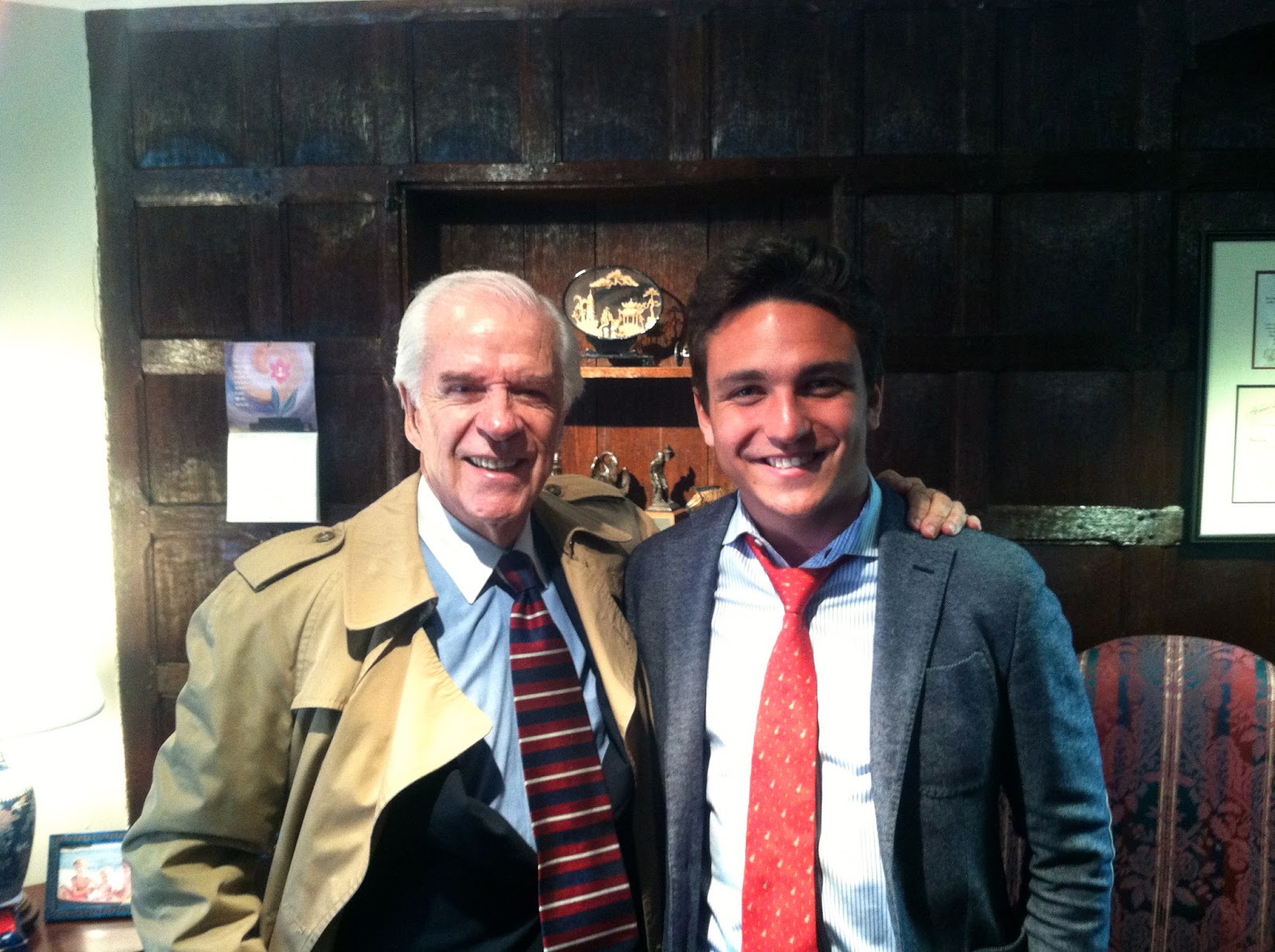
Ben Custer '10 and I are just back from a trip to Gettysburg for the 150th anniversary of the famous battle there. Beyond thwarting a rebel invasion and preserving democracy, our agenda included lunch with Fred Michel '77 at an Irish Pub in town. It was great fun to meet Fred and hear some of his stories of the Trautman era. We also, frankly, spent a great deal of time talking about the Civil War and about the history of Frederick, Maryland, where Fred lives.
With Ben Custer '10, and Fred Michel '77
I would have more to say about our conversation, but my memory has been obscured by being killed four times in as many days (yes, we spent four days reenacting a three day battle; these things take time), wearing heavy blue wool in the heat of midsummer, and so on. One aspect of the lunch I will not soon forget is Fred's generosity. He had planned to pay for lunch, but our waiter announced that Ben's and my meals had been paid for by the gentlemen at the next table. They had been at the battle that morning or the day before, and they wanted to thank us (as representatives of the reenacting community) for making it possible for them to get a sense of what had happened 150 years earlier. Fred, not to be outdone, gave the folks his card and generously offered to show them around the various points of interest in nearby Frederick. Having spoken with Fred, I know a) that there is a great deal to see in Frederick, Maryland, and b) that Fred's knowledge and enthusiasm for the area make him an ideal tour guide; I do hope the good folks took him up on the offer. In any event, it was a nice display of community/generosity on Fred's part.

Thursday, June 20, 2013

Grandparents Day

If you look at the Colombian flag that hangs in the Refectory, you will see the name German Lopez on the plate - this was the first flag added to the Refectory.  On Grandparents Day, I got a chance to chat with German, who was on campus visiting his grandson Luis Jaramillo '15.  Lopez, known as "Lopey" at the time, was Warden of the class of '49, the first class to graduate after the school re-opened.
German Lopez '49 & his grandson, Luis Jaramillo '15
As Warden, German had frequent meetings in Don Pierpont's house, and German remembers Pierpont very fondly.  Other memories in include making coffee and roasting marshmallows in the working fireplace in his room, being "an item" with Frank Leavitt's older sister Carol (the Leavitt family rented space in the Quad in those days), and meetings of an elite group - was it the Order of Old Farms? - in a room upstairs in the Water Tower.  He used to babysit for the Kincaid family and once borrowed their car, fell asleep, and drove it into an apple tree!  German says the accident caused no big fuss, which I am inclined to believe given the number of crashing-the-borrowed-faculty-car stories that seem to emanate from the Pierpont years! Apparently German Lopez set the precedent.

Tuesday, April 16, 2013

Happy Birthday "Nails"

George Trautman turned 80 on Tuesday, April 16th.  Though George retired as headmaster over a decade ago, he is still an active member of the school community.  He does some work for the Alumni and Development office, and it is not unusual to see George at games or at Sunday brunch.
George first came to Avon in the late '60s as a member of a Visiting Committee completing a ten-year re-accreditation.  He fell in love with the school and hoped he was destined to return.  At that time, he was a member of the faculty at Tabor Academy, where he earned the nickname "Nails."  That nickname must have rung true for Avonians as well when George was hired to succeed Don Pierpont and took over as headmaster in the fall of 1969.
This portrait of George hangs in the Estabrook Board Room
George had scores of signature moments in his nearly three decades at the helm, but one of them came on Day 1, when George famously required long-haired students to get haircuts before they would be allowed to register.  "Nails" might have been one of the nicer things George was called that day!
One thing that always struck me about George was his remarkable instincts for this work.  He always seemed to know what questions would lead directly to the heart of the matter and how to respond once he got there.  At times, it almost seemed as though George had a "sixth sense."
On one such occasion, my wife woke me up in the middle of a late spring night to report odd noises emanating from the Quad.  A senior prank, perhaps?  When we looked out the window, we saw some seniors somehow hoisting a canoe up into one of the big trees near Eagle.  I started to get dressed, pondering exactly what I might say to a group of seniors bent on some sort of canoe-tree mischief, when a second look out the window revealed the canoe being being lowered back to the ground.   What had caused the pranksters to change course?  George was standing just inside Eagle Archway staring intently at the proceedings.  If he said anything, I did not hear it, but the boys were quickly about the business of undoing their handiwork and slinking off the bed.  When I asked George later on how he had known what was going on - had he heard noises from the Quad? - he said he was not sure; he woke up and somehow knew that going for a walk was a good idea.

Monday, March 4, 2013

A Letter

Recently, archivist Carol Ketcham sent over a copy of a letter TPR sent to Gilman Ordway '44 in December of 1945.  She was pleased to have had a letter from Ordway, then a student at Yale, and pleased to learn he was rooming with Eddie Custer '43.  TPR clearly knew the boys; she knew that Eddie had served in India during the war and that he wrote poetry, and she knew Gilman was a writer as well (he has a neat story in the '44 yearbook).
She filled Ordway in on the activities of the Army on campus, especially the improvements such as the sprinkler system and the new pool, and she went on to express her hope that Avon would one day re-open as a school.  "Your letter," she wrote, "and the letters from other Avon boys, telling me you stand ready to support the school, cheer my heart."
It comes as no surprise that alumni supported the idea of re-opening the school.  It did, after all, re-open in 1948, something that could not have happened without a great deal of suport from alumni.  Neither is it a surprise that TPR knew and took an active interest in some recent alumni.  While she was not a constant presence on campus during the Founder's Era, she was here from time to time, and every alumnus of the period I have met can recount at least one story of meeting Mrs. Riddle.  TPR was fond of the quotation "by their fruits ye shall know them," and she said more than once that the school was her life.  In that context, one can only imagine how she felt about the school's closing (too distraught to attend Commencement in '44, she sat in her car on Dio circle) and how fervently she would have looked for signs that a re-opening would "take."

Sunday, February 17, 2013

Henry Coons '71

After a few technical issues, I've finally been able to review the  video of my interview with Henry Coons '71.  Henry enrolled in 1968 and has been at school for all but five of the intervening years.  A few stories from his student days: In Henry's first year, the school discovered his roommate was selling drugs.  Since the roommate was off campus at the time, they simply told him not to return.  The roommate wanted his stuff back, though, so Henry agreed to drop it off in Greenwich on his next trip to New York.  When he got on a train with the roommate's duffel bag, Henry realized it was an express train not scheduled to stop in Greenwich.  Uncertain about what to do, Henry tossed the bag out the window as they rolled through Greenwich station and then left a message for his former roommate.  He had no way of knowing whether it had worked until on a subsequent trip to New York he saw a homeless man wandering the tracks outside Greenwich wearing some of the roommate's distinctive clothing!
At the start of his second year, Henry's view from his room in Diogenes afforded him a good view of registration and new headmaster George Trautman enforcing the haircut policy by sending students to the barber before they could move in.   He also remembered doing science labs that involved live rats.  In one lab, Henry's lab partner was the anesthesiologist, while Henry was the perform some sort of rat surgery.  Unfortunately, his lab partner feinted, the rat's ether wore off, and the rat ran off before Henry could finish.  Henry now works in the old science building; no word on whether he has encountered an aged, deformed rat in the hallways.