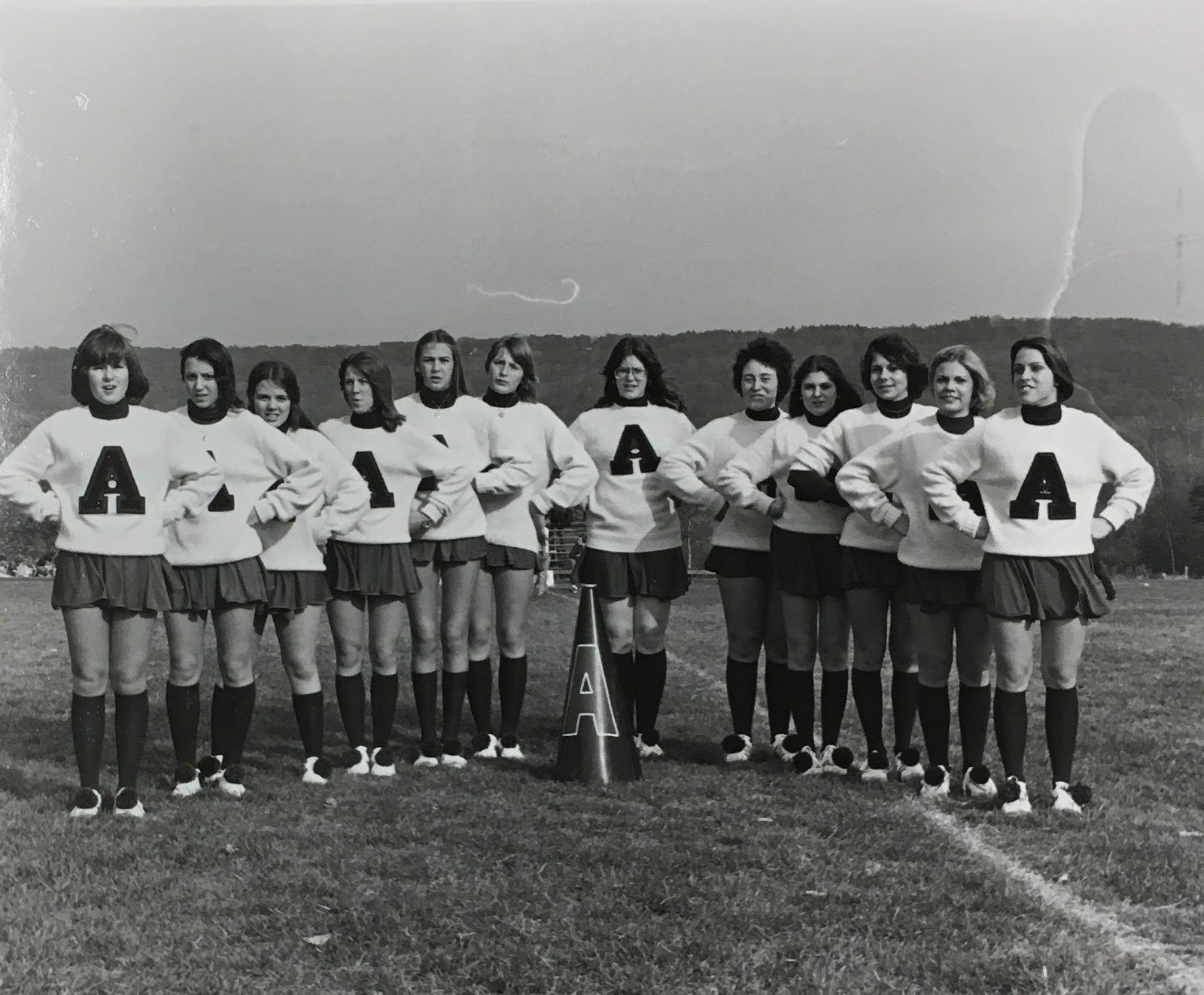
We had a lot of fun discussing what the story of this picture might be, but we learned the truth in conversation with Peter Evans and George Trautman. It seems it was part of a mid-seventies effort to drum up school spirit. Some of the boys recruited girls they knew to serve as cheerleaders and create an enthusiastic atmosphere at games. It was a short-lived experiment, but perhaps it worked. Could it have led directly to the Avon Army?
-Theodate Pope RiddleThere should be some oases in this country where the love of tradition is fostered. Avon shall be one of these oases where, when Avonians return, they will find at least a semblance of permanence.
Sunday, January 17, 2016
Yea Rah!
Avon has recently concluded its first "Intersession," a week in which we suspend the normal academic program, and students and faculty devote their attention to only one of thirty non-traditional courses. My own offering was called "Exploring AOF History," and the idea was that students would delve deeply into a particular aspect of school history and create something that might help the school celebrate its centennial. Not surprisingly, the boys chose to investigate the history of sports at Avon. They got to explore the archives, they interviewed two Avon headmasters and several coaches, and they learned about Avon's traditions in polo, fencing, and jiu jitsu. They also discovered this photograph.
Sunday, September 27, 2015
Thank You, Reed
This year, George Trautman used his Vespers talk to pay tribute to F. Reed Estabrook '36, who served for many years as Chairman of the Board of Directors. George characterized Reed as "the second most important person" in the history of the school (after TPR), and I doubt there are many who would disagree.
Reed was among those who were instrumental in the re-opening of the school in 1948, and he was the youngest member of the Board at that time. Avon had no money and no endowment in those years, and Reed would prove to be an invaluable counselor to Don Pierpont and then George Trautman as they worked to keep the ship afloat. George noted the incredible growth of the school since '48 and observed that the strong position we now occupy would be part of Reed Estabrook's legacy. Mr. Trautman offered some insight into the relationship between the headmaster and chairman when recalled the story of a student's death on the playing fields. Losing the boy had left George essentially numb, and it was Reed Estabrook who pulled him aside and convinced him he had to keep going.
It was a fitting tribute to a man who gave tirelessly to his school and who would come to campus at the drop of a hat. For some reason, as soon as George began to speak about Reed, I was overwhelmed by the memory of how students enjoyed Reed's accent, especially when, having been introduced by the headmaster at some formal function, Reed would step to the podium and say "Than you, George." I remember more than once walking out of such an assembly behind students endless repeating "Thank you, George" in their best Boston accents.
This year, it was George's turn to say "Thank you, Reed."
Friday, May 1, 2015
Another Snippet About TPR
In late April, I had a first appointment with a new doctor, and it turned out that he had lived for some time in a house that was once part of the Hill-Stead property and had met a number of people with first-hand experience of TPR. The one anecdote he told comes from TPR's attorney, whom the good doctor got to know well. It seems TPR and her attorney were returning to Hill-Stead in her car when they came upon a couple of town officials who were looking at the sharp turn on Mountain Road near the Hill-Stead entrance. When TPR stopped to find out what they were up to, they suggested there might be a way to make the turn safer but that it would require that TPR yield a small piece of property. TPR turned to her attorney and asked "Do I have to do this?" When he responded that she did not, she turned to the two officials and said simply "no."
So what does this anecdote tell us? I suppose it is encouraging to those inclined to think of TPR as overbearing and difficult to deal with. Certainly it reinforces the notion that she was strong-willed and decisive, but we knew that already. We also knew she was eccentric, which raises a number of questions for me. First is the classic question about TPR and her era: did she somehow drive away three Provosts and two entire faculties and in so doing force her school to close? Second is what does "eccentric" mean in the context of a strong-willed woman in the early twentieth century?
So what about this idea that TPR was overbearing, perhaps overly meddlesome, and the trials of the Founder's Era were entirely of her own creation? Certainly there were those in her day who took that view. Cal Magruder '46 reports that the perception among students in '44 was that the troubles came as result of disputes between TPR and Brooks Stabler, and the faculty and students collectively sided with Stabler. Of course, like most Founder's Era alumni, Cal also reports he did not see much of TPR and that she was not a presence on campus.
By the way, the good doctor has since moved out of the house that was once part of Hill-Stead, but he now lives in Devonwood, which was of course once part of the school property, so in some ways he simply traded one former TPR estate for another.
Monday, November 10, 2014
Twilight Zone
Recently, I visited a class taught by new colleague Paul Duwan '85 and had a "Twilight Zone" experience. This was one of Paul's younger classes (he also teaches economics to seniors), and that day he was introducing the Renaissance. As I sat in class, I realized that when I first introduced the Renaissance to a class, Paul was one the students. Paul is not the first of my students to become a colleague, but I believe this is the first time I have seen the roles reversed so completely
![]() |
| Paul Duwan '85 teaching A.P. Economics |
![]() |
| Chandra Narsipur |
Tuesday, January 28, 2014
Pete Seeger '36 - An Appreciation
If the world seems like a slightly colder, darker place today, it is because Pete Seeger '36 died yesterday at the age of 94.
| Pete Seeger '36 in Brown Auditorium, 2008 |
Of course, Pete was a giant in folk music. He wrote, or had a hand in writing, such folk standards as Where Have All the Flowers Gone, If I Had A Hammer, Turn, Turn, Turn, and We Shall Overcome, among many, many others. Pete’s music always had a social conscience. In his early years, he sang the songs of the Labor Movement with the Almanac Singers and then The Weavers. He also consistently lent his voice (and his banjo) to the struggles for Civil Rights {We Shall Overcome}, Peace {Bring ‘Em Home} and Environmental Responsibility {Sailing Down My Golden River}. For many, his Vietnam-era songs such as “Waist Deep in the Big Muddy” are particularly poignant today.
Frankly, however, the category “Things To Admire In Pete Seeger’s Life” contains much more than musical brilliance and socially conscious songs. Throughout his life, Pete demonstrated extraordinary courage and commitment to justice. In the 50s, he stood up to the notorious House Committee on Un-American Activities, telling them I am not going to answer any questions as to my associations, my philosophical or religious beliefs or my political beliefs, or how I voted in any election, or any of these private affairs. I think these are very improper questions for any American to be asked, especially under such compulsion as this. I would be very glad to tell you my life if you want to hear of it. A Just Man living in an Unjust Society, Pete was ultimately convicted of Contempt of Congress, sentenced to a year in jail, and blacklisted for 17 years. In the 60s, Pete decided to launch a campaign to clean up the Hudson River. Using the sloop Clearwater as his platform, he has succeeded to a remarkable degree – mostly by calling attention to the problem and by inspiring a grass-roots movement in response.
Pete Seeger changed millions of lives with his music and his activism. He did it without compromising his values and without fear for his own reputation or safety; he did it with boundless optimism and the conviction that there is nothing the people cannot accomplish, and he did it by bringing people together, recognizing the value in each of us and in all of us, and by inspiring us with his commitment, his vision, and his song.
In Pete Seeger's life there is much much for us to admire, to celebrate, and to seek to emulate. The world is in fact a better, brighter place because of him.
Thursday, October 17, 2013
"Men of Avon" Video
Earlier this fall, Bryan Zaros, our director of choral activities, put together this video to celebrate the history of "Men of Avon." If you have not yet seen it, do take a look. Thanks to Bryan, his choral groups, Archivist Carol Ketcham, and everyone else who had a hand in this video.
Sunday, October 6, 2013
Don Pierpont Saved My Life
On the occasion of the sixty-fifth anniversary of the school's re-opening and the forty-fifth anniversary of Don Pierpont's death, Pierpont-era alumni gathered on campus this weekend to remember their Provost at a dinner and fireside chat on Friday evening and a Chapel service on Saturday morning. At both events, participants stood up and spoke about their particular memories of "Pierps."
There were, frankly, tears shed in both the Commons Room (Friday evening) and the Chapel as alumnus after alumnus recounted the profoundly positive impact that Don Pierpont had on their lives. Many stories followed the same outline: confronted with a vulnerable, unsuccessful, perhaps misbehaving boy or young man, Pierpont somehow saw potential no one else could recognize, provided a second (or more) chance and then helped the young lad find - and believe in - his best self. Pierpont's legendary compassion was on full display, perhaps best in the story of a meeting between Pierpont, a student, and Dean Kincaid. The dean pointed out that the student was failing most of his classes, had been drinking in the dorm, and had recently stolen Pierpont's car! Pierps's response? "Don't confuse me with facts"! That student stayed at Avon, graduated, and is grateful to Don Pierpont for the happy life he has enjoyed since then.
Of course, as with any gathering at which Don Pierpont is remembered, there were repeated references to Ho Jo's!
| The Chapel Ready for the Don Pierpont Service |
Of course, as with any gathering at which Don Pierpont is remembered, there were repeated references to Ho Jo's!
Subscribe to:
Posts (Atom)

